
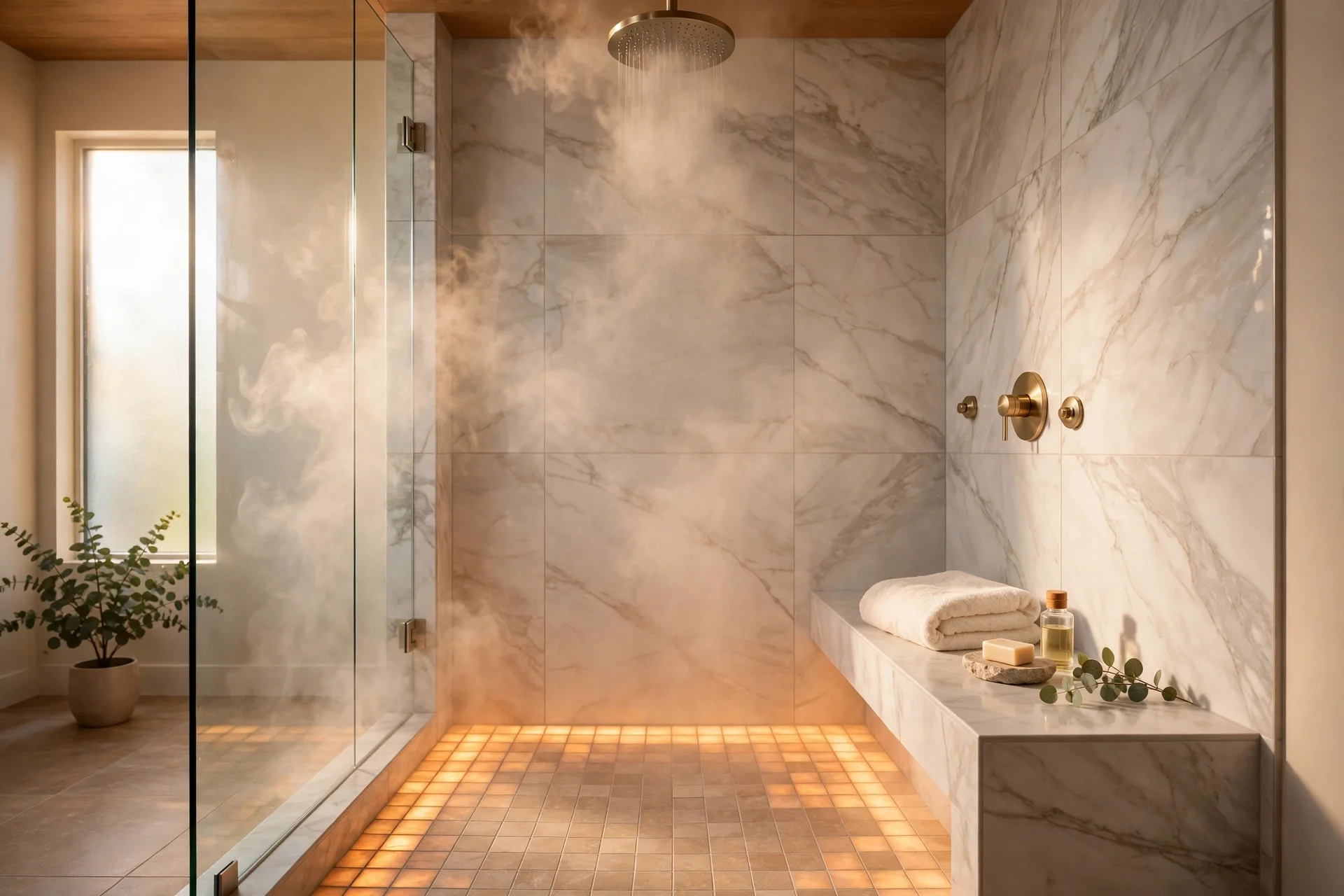
Warm Feet, Warm Mornings: Heated Tile Floors for Your Custom Shower
Step into a tile shower on a cold January morning in Evansville and you will feel it before anything else: the floor. Tile is beautiful, durable, and easy to clean — but on a winter morning, it can be cold enough to make you hesitate. A heated tile floor fixes that, and it is one of the most popular upgrades homeowners ask for when they remodel a shower.
Here is how heated shower floors work, what they cost, and why they pair so well with a custom tile shower.
What Is a Heated Tile Floor?
A heated tile floor — also called radiant floor heating — is a thin electric heating mat or cable installed underneath the tile, right on top of the shower's waterproofing layer. When you turn it on, it gently warms the tile from below. There are no hot spots, no noise, and nothing to see: the heat is hidden completely under the tile.
The system is controlled by a small thermostat on the bathroom wall, just like the one for your furnace. Many homeowners set it on a timer so the floor is warm when they wake up and off again by the time they leave for work.
Why It Works So Well in a Shower
Tile and radiant heat are a natural match. Tile holds and spreads heat evenly, so the whole floor warms up instead of just a few spots. That matters in a shower more than anywhere else in the bathroom, because the shower floor is the one surface your bare feet touch every single day.
A heated shower floor also helps the shower dry out faster after use. A warm floor evaporates leftover water more quickly, which means less standing moisture, less mildew, and a shower that stays cleaner between cleanings. It is a comfort upgrade and a practical one at the same time.
The Best Time to Add It Is During a Remodel
Heated floors go in underneath the tile, so the right time to add one is when the shower is being built or rebuilt — not after. That is exactly why it fits so naturally into a custom tile shower project. The shower is already being taken down to the studs, the floor is already being waterproofed, and the heating mat goes in as one more layer before the tile is set.
Trying to add heat to an existing tile shower would mean tearing the floor out. Building it in from the start costs far less and gives a cleaner result.
What Does It Cost?
For a typical shower, the heating mat, thermostat, and installation usually add a few hundred dollars to the project — a small share of a custom tile shower that runs $7,000 to $8,000. The mat itself is sized to the shower, so a compact shower costs less to heat than a large walk-in with a bench.
Running costs are low, too. A shower floor uses far less electricity than heating a whole room, and most homeowners run it only in the morning and evening. Many people spend less on it each month than they do on a single streaming subscription.
What About Safety?
Electric heat and water sound like a bad combination, so it is fair to ask. Heated shower floors are built for exactly this job. The heating cable is fully sealed and waterproof, it sits under the tile and grout, and the system is protected by a ground-fault circuit interrupter — the same kind of safety device that protects the outlets in your bathroom. A licensed electrician makes the final connection, and the system is tested before the tile ever goes down.
Pair It With the Rest of the Shower
A heated floor is at its best when it is part of a complete custom shower: a curbless entry, a built-in bench, a niche for shampoo and soap, and a rainfall showerhead overhead. The warm floor ties it all together and turns a daily routine into something you actually look forward to.
If you are already planning a custom tile shower, adding heat is a small step that changes how the whole shower feels — every single morning, all winter long.
Start With a Free Estimate
River City Flooring Pros builds custom tile showers in Evansville, Indiana, in about one week, for $7,000 to $8,000. If you would like a heated floor in yours — or you just want to talk through tile, layout, and options — call (812) 454-1631 for a free estimate. We will help you design a shower that feels as good as it looks.
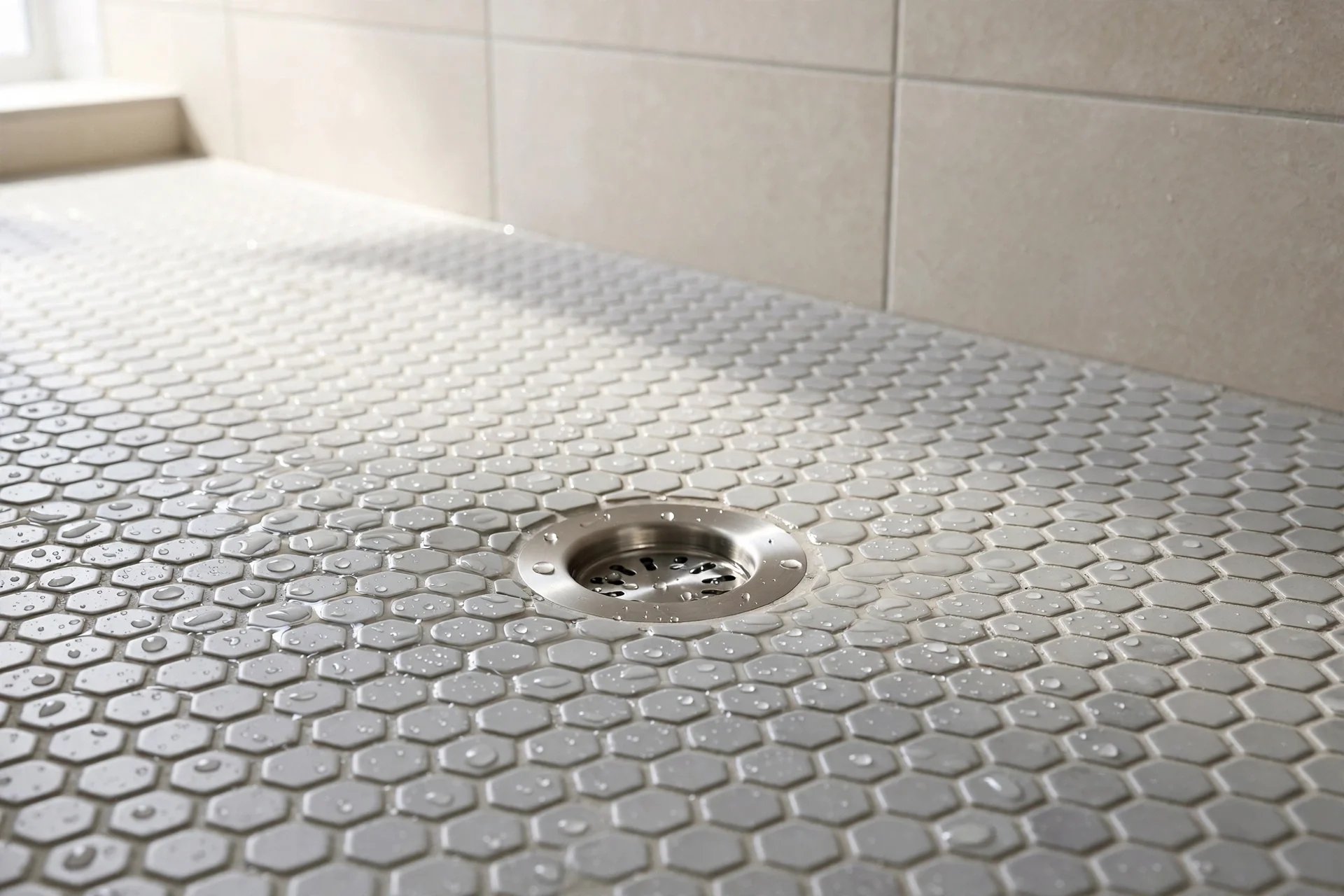
Small Tiles, Sure Footing: Choosing the Right Tile for Your Shower Floor
Walk into any custom tile shower and the walls get all the attention. But the tile under your feet is the one doing the hardest work. It gets wet every single day, it takes your full weight on a soapy surface, and it has to drain perfectly for years without a single leak. Picking the right shower floor tile is not just a style choice — it is a safety and durability choice.
Here is what Evansville homeowners should know before choosing tile for their shower floor.
Why Shower Floors Use Small Tiles
Most custom shower floors are covered in small mosaic tiles — usually 2-inch squares, hexagons, or penny rounds — and there is a good reason for it. A shower floor is not flat. It slopes gently toward the drain, about a quarter-inch per foot, so water runs off instead of pooling.
Small tiles can follow that slope. Large tiles cannot bend, so they have to be cut into pieces to fit the slope, which means more seams and a harder install. A mosaic floor follows the slope naturally, drains better, and looks like it was made for the space — because it was.
Slip Resistance Matters More Than Looks
A shower floor is wet and soapy, so grip matters. Two things give a shower floor its grip:
Texture. Matte and textured tiles grip better than polished, glossy ones. A polished marble-look tile that feels fine dry can turn slick the moment it gets wet.
Grout lines. Every grout line is a tiny bit of extra traction. That is another reason mosaics work so well on shower floors: all those grout lines add up to a surface that is much harder to slip on than one big, smooth tile.
When you are shopping, look for tile rated for wet areas. Your installer should be able to tell you whether a tile is a safe pick for a shower floor — if they cannot, that is a red flag.
What About Large-Format Tile on the Floor?
Large-format tiles — 12x24 and bigger — look great on shower walls, and some homeowners want the same look on the floor. It can be done, but it takes a skilled installer, a perfectly built slope, and usually a linear drain instead of a center drain so the floor can slope in one direction.
For most Evansville bathrooms, the smart move is large-format tile on the walls and mosaic on the floor. You get the clean, modern look where you see it most, and the grip and drainage where you need it most.
Grout: The Part People Forget
Grout holds the floor together, and on a shower floor it takes a beating. A few things to know:
Epoxy grout costs more than standard cement grout, but it resists stains, mold, and water far better. On a shower floor — the wettest surface in the house — it is worth the upgrade.
Darker grout hides discoloration and soap residue better than white. If you love the look of white grout, plan on sealing it and cleaning it regularly.
Sealing matters. Cement grout should be sealed after it cures and re-sealed every year or so. A sealed floor is easier to clean and lasts much longer.
Drainage: The Slope You Never See
A good shower floor drains completely within a minute or two of turning the water off. If water pools around your feet, the slope is wrong — and standing water leads to mold, stained grout, and eventually leaks.
This is why the floor is built on a properly sloped mortar bed over a waterproof membrane, not just tile glued to a flat surface. Waterproofing goes underneath the tile, so even the water that soaks through the grout has somewhere safe to go. It is the part of the job you never see, and the part that matters most.
How to Keep a Tile Shower Floor Looking New
Rinse the floor after each shower to wash away soap film.
Squeegee or towel-dry the floor once a week to slow down water spots and mildew.
Use a pH-neutral tile cleaner — harsh acids and bleach wear grout down over time.
Re-seal cement grout about once a year.
A well-built tile shower floor should last decades with that kind of basic care.
The Bottom Line
Small mosaic tile, a textured finish, quality grout, and a proper slope to the drain — that is the recipe for a shower floor that is safe, drains well, and still looks great years from now. Get those four things right and the rest of the shower is easy.
River City Flooring Pros builds custom tile showers across Evansville and the tri-state — one-week installs, $7,000–$8,000, free estimates. Call or text (812) 454-1631 to plan your shower.
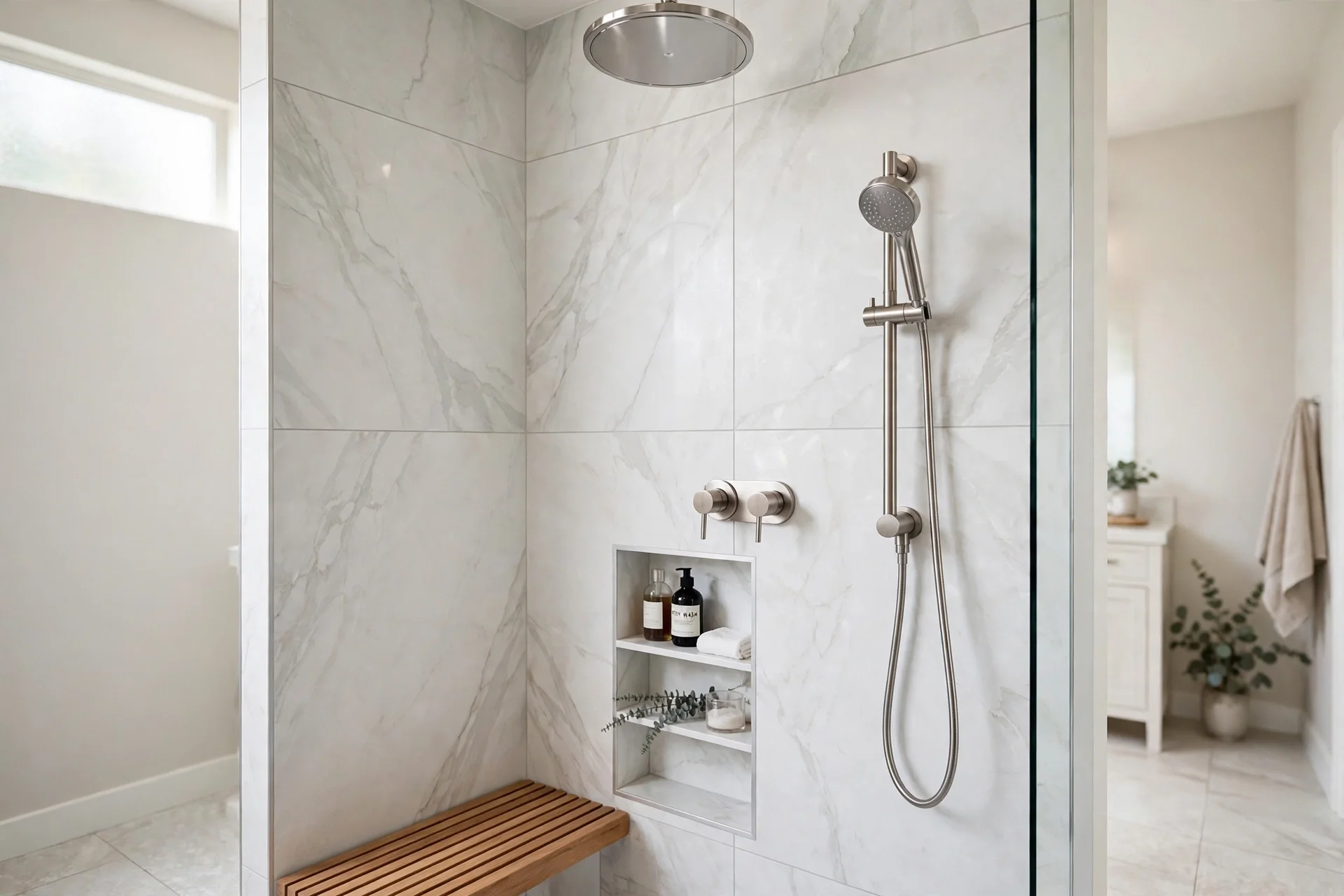
Rain Heads, Handhelds, and Valves: Choosing Fixtures for Your Custom Tile Shower
You can pick beautiful tile and get the waterproofing exactly right, and still end up with a shower that does not feel good to stand in. The fixtures decide that part. The shower head, the handheld sprayer, and the valve behind the wall are what turn a good-looking shower into one you actually enjoy every morning.
Here is how Evansville homeowners should think about fixtures when planning a custom tile shower.
The Shower Head: Rain, Standard, or Both?
Rain heads are the wide, flat heads mounted overhead — either from the ceiling or on an arm from the wall. Water falls straight down over your whole body instead of spraying at an angle. It feels calm and spa-like, and it is the single most popular choice in the custom tile showers we build. The trade-off: because the water falls straight down, it does not rinse shampoo out of long hair as quickly as an angled head.
Standard wall-mounted heads spray at an angle and cover a smaller area, but they rinse faster and cost less. If you are keeping the budget tight, a good standard head is a perfectly fine choice.
The best of both: a lot of our customers pair a rain head with a second, standard head or a handheld sprayer. You get the relaxing rain for everyday showers and a stronger spray when you need it.
The Handheld Sprayer: Small Fixture, Big Difference
A handheld shower sprayer on a slide bar or wall hook is the fixture most people forget to ask for — and the one they miss most if it is left out. It makes rinsing the shower walls easy, it is a lifesaver for bathing kids or pets, and it helps anyone with limited mobility shower safely while seated on a bench.
Handhelds cost very little to add during a remodel, because the plumbing is already open. Adding one later means opening the wall again. If you are building a custom tile shower, put the handheld in now.
The Valve: The Part You Never See (Until It Fails)
The valve sits behind the tile and controls water temperature and flow. There are two main kinds:
Pressure-balance valves keep the temperature steady when someone flushes a toilet or runs the dishwasher. They are reliable, affordable, and the standard in most homes.
Thermostatic valves let you set an exact temperature — say, 102 degrees — and hold it there, with a separate control for water volume. They cost more, but they give you a consistent shower every single time, and they are the right call if your household has kids or older adults who need scald protection.
Whichever valve you choose, spend the money on a quality brand. A cheap valve fails behind the wall, and fixing it means cutting tile. A good valve lasts decades.
Finishes That Hold Up
Chrome is the easiest to clean and the least expensive. Brushed nickel hides water spots better and matches most bathroom hardware. Matte black looks sharp in a modern shower but shows soap spots more, so plan on wiping it down. Oil-rubbed bronze gives a warm, traditional look. Pick a finish that matches the rest of your bathroom — and buy all the fixtures from the same line so the finishes match exactly.
What Fixtures Add to the Cost
On a custom tile shower in Evansville, fixtures usually run from a few hundred dollars for a solid standard set to $1,000 or more for a rain head, handheld, and thermostatic valve in a premium finish. That is part of the $7,000–$8,000 range for a complete custom tile shower from River City Flooring Pros — one week, start to finish, with a free estimate up front.
The Bottom Line
Start with a rain head if you want the spa feel, add a handheld sprayer while the wall is open, and put a quality valve behind the tile. Those three choices are what make a custom tile shower feel custom every single day — not just the day it is finished.
River City Flooring Pros builds custom tile showers across Evansville and the tri-state — one-week installs, $7,000–$8,000, free estimates. Call or text (812) 454-1631 to plan your shower.
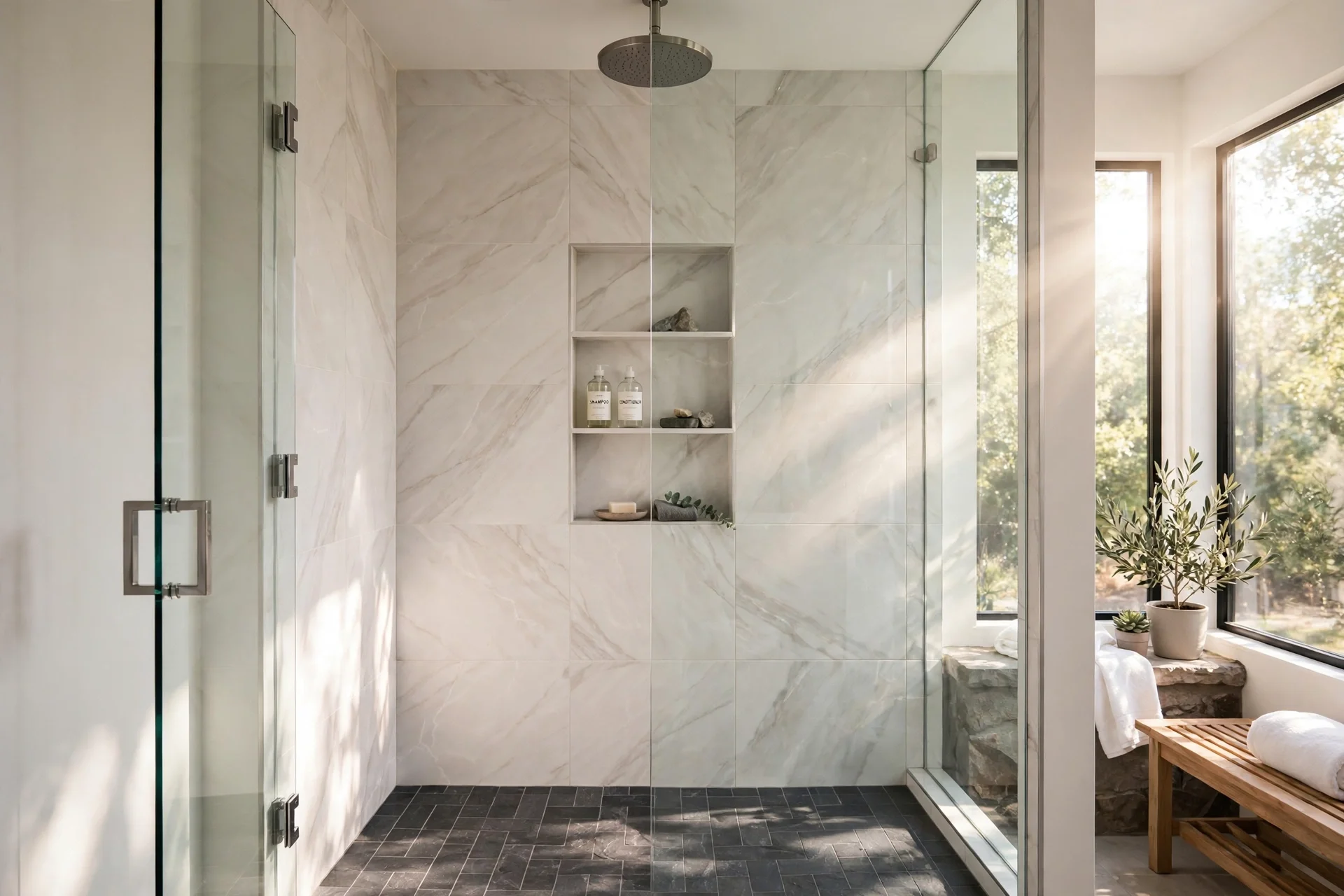
Frameless Glass Doors: The Finishing Touch on a Custom Tile Shower
You can pick the perfect tile, get the waterproofing right, and build a beautiful niche — and still have a shower that feels dark and closed in. The one thing that changes that more than anything else is the door. A frameless glass door does not just close off the shower. It shows off the tile work, lets the light through, and makes the whole bathroom feel bigger. Here is what Evansville homeowners should know before choosing glass for their custom tile shower.
What "Frameless" Actually Means
A frameless glass door has no metal frame around the glass panels. Instead, the glass is held in place by a few small clips and hinges, and the edges are sealed with clear vinyl strips. The glass itself is thicker than the glass in a framed door — usually 3/8 inch or 1/2 inch — so it is strong enough to stand on its own. The result is a clean, open look. There is no bulky aluminum frame breaking up the view of your tile, and nothing for soap scum to hide behind.
Why Homeowners Choose Frameless Glass
It shows off the tile. If you are investing in a custom tile shower, you want to see it. Frameless glass keeps the tile on display from anywhere in the bathroom.
It makes small bathrooms feel bigger. A clear glass panel does not chop the room in half the way a framed door or a shower curtain does. Light passes through, and your eye travels all the way to the back wall.
It is easier to clean. Fewer metal tracks and frames means fewer places for mold and mineral buildup to collect. A quick squeegee after each shower goes a long way.
It lasts. Tempered safety glass and solid brass or stainless hinges are built to hold up for decades. There is no flimsy track to bend or corrode.
Glass Thickness: 3/8 Inch vs. 1/2 Inch
Most frameless doors use 3/8-inch tempered glass, which is sturdy, looks great, and keeps the cost down. For larger panels, heavy doors, or a truly high-end feel, 1/2-inch glass is the upgrade. It feels more solid when it swings, it flexes less, and it gives the shower a more substantial, luxury feel. Either way, the glass is tempered safety glass — the same kind used in car windows. If it ever breaks, it shatters into small, rounded pieces instead of sharp shards.
Clear, Frosted, or Textured?
Clear glass is the most popular choice, and for good reason: it shows off the tile and makes the room feel open. But it is not the only option. Clear glass shows everything, including water spots, so it needs a quick wipe or squeegee to stay spotless. Frosted or rain glass gives privacy and hides water spots, at the cost of hiding some of the tile work. Low-iron glass is a premium clear option with almost no green tint at the edges. It looks especially good with white or light-colored tile. If privacy matters, frosted glass on a single panel — or a frosted band across the middle — can give you the best of both worlds.
Hardware and Finishes
The hinges, handles, and clips are the jewelry of the shower door. Matte black is the most popular finish right now, and it pairs beautifully with both light and dark tile. Brushed nickel, chrome, and brushed gold are all good options too. The key is matching the hardware to the rest of the bathroom — the faucet, the showerhead, and the towel bars. When the finishes match, the whole room looks like it was planned together, because it was.
What About Leaks?
This is the question we hear most, and it is a fair one. A frameless door does not seal as tightly as a framed door, so a small amount of water can escape through the gaps at the hinges and along the bottom edge. That is normal, and it is handled in the design: the shower floor is sloped toward the drain, so water runs away from the door, not toward it; a small threshold or curb keeps water inside the shower area; clear vinyl seals along the door edges block splashes without being visible. When the shower is built and sloped correctly — which is part of every custom tile shower we install — a frameless door stays dry on the outside.
Keeping Glass Looking New
Frameless glass is easy to care for if you build a small habit into your routine: 1. Squeegee after every shower. It takes 15 seconds and prevents water spots and mineral buildup. 2. Use a mild cleaner once a week. A simple mix of water and white vinegar, or a non-abrasive bathroom cleaner, is all you need. Avoid harsh chemicals that can damage seals and hardware. 3. Seal the glass once a year. A glass sealant makes water bead up and roll off, so spots have a harder time sticking. With that routine, frameless glass stays clear and beautiful for years.
What Does a Frameless Glass Door Cost?
A frameless glass door for a standard custom tile shower in Evansville typically runs between $1,000 and $2,500 installed, depending on the size of the opening, the glass thickness, and the hardware finish. Larger panels, custom angles, and 1/2-inch glass sit at the higher end. That cost is part of the overall custom tile shower price, which at River City Flooring Pros runs $7,000 to $8,000 for a complete one-week install. The glass is one of the most visible parts of the finished shower, so it is money well spent.
The Bottom Line
A custom tile shower is an investment in your home, and the glass door is what lets you enjoy it every day. Frameless glass shows off the tile, opens up the bathroom, and is easy to keep clean — all while lasting for decades. If you are planning a custom tile shower in Evansville, we would love to help you design it, from the tile and the niche right down to the glass and the hardware. Every shower we build is a one-week install, built to last, with a free estimate up front. Call River City Flooring Pros at (812) 454-1631 to schedule your free estimate. Let's build the shower your bathroom deserves.
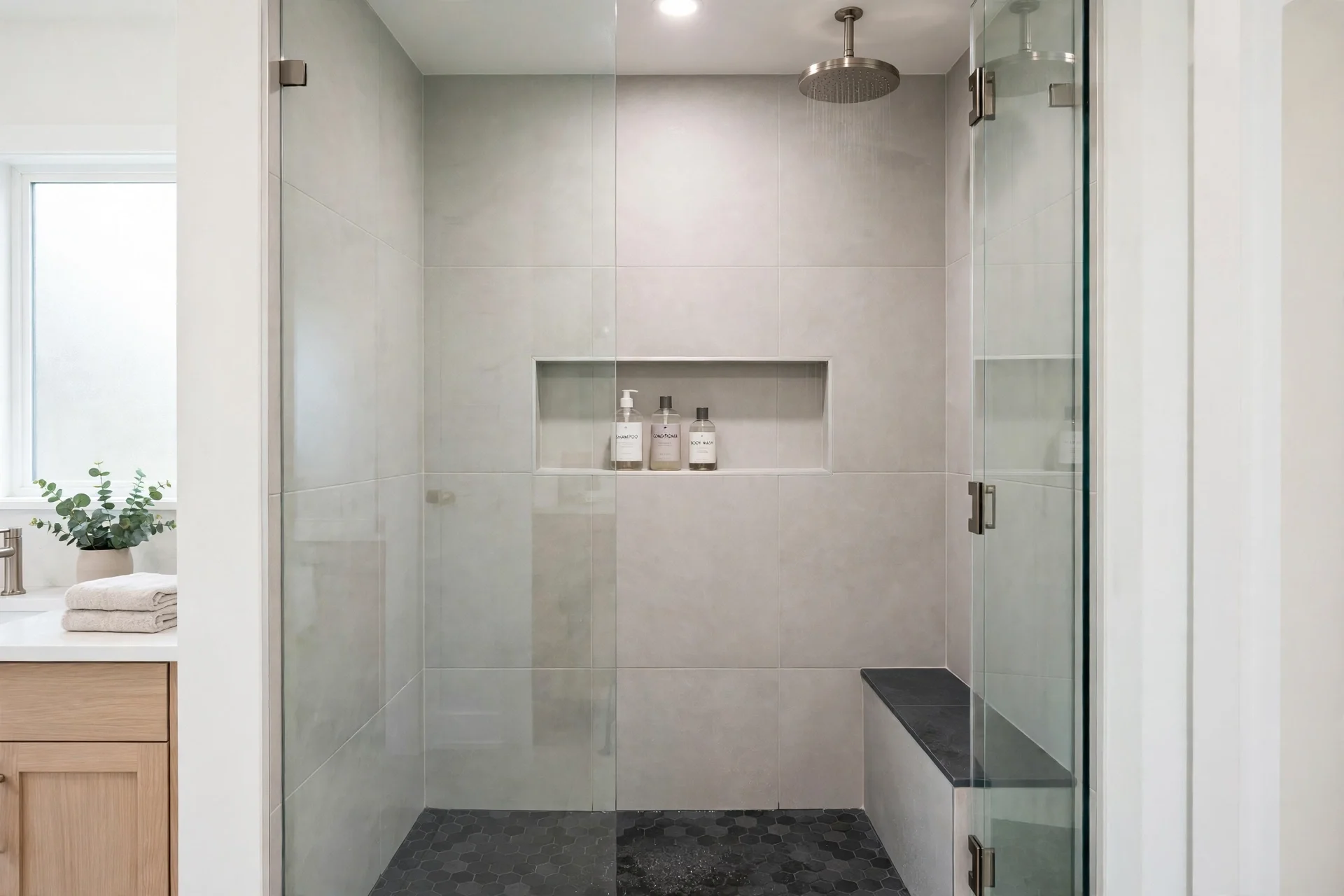
From Old Tub to Walk-In Tile Shower: What Evansville Homeowners Should Know
If your bathtub mostly collects dust — or laundry — you are not alone. All over Evansville, homeowners are pulling out old tubs and replacing them with walk-in custom tile showers. The change is one of the most popular bathroom upgrades we build at River City Flooring Pros, and for good reason: a walk-in shower is easier to use, easier to clean, and it makes the whole bathroom feel bigger.
Here is what a tub-to-shower conversion actually involves.
Why Homeowners Are Ditching the Tub
Most of the tubs we remove are rarely used for soaking. They take up a lot of floor space, they are hard to step into and out of, and the fiberglass surround around them is often stained, cracked, or hiding water damage behind it.
A walk-in tile shower fixes all of that at once:
No high wall to climb over. You walk straight in, which is easier on knees, hips, and backs.
More usable space. The same footprint feels roomier without a tub wall boxing it in.
A cleaner look. Large-format tile and a glass panel open up the room in a way a tub surround never will.
Built for daily use. A shower you actually use every day beats a tub you use twice a year.
If you have another tub somewhere else in the house, giving up this one costs you nothing. And if you are planning to stay in your home long-term, a walk-in shower is one of the smartest aging-in-place upgrades you can make.
What the Conversion Looks Like
A tub-to-shower conversion follows the same one-week rhythm as any custom tile shower we build.
Day one is demo. The tub comes out, along with the old surround, tile, and any damaged drywall behind it. This is also when we see what is really going on behind the walls — old plumbing, water damage, or framing that needs attention. We fix what we find before anything new goes in.
Then comes plumbing and waterproofing. The drain usually moves, because a shower drain sits in a different spot than a tub drain. The shower valve gets set at a comfortable height, and the walls get a full waterproofing system — the same careful membrane and sealing work we use on every shower we build. A tile shower is only as good as what is underneath it, so this step never gets rushed.
Then the tile goes up. This is where the conversion starts to feel real. Homeowners usually pick a large-format tile for the walls — fewer grout lines, easier to wipe down — and a smaller, slip-resistant tile for the shower floor. A built-in niche for shampoo and soap is the single most-requested feature, and this is the time to add one.
Finally, glass and fixtures. A frameless or semi-frameless glass panel keeps the space open and lets the tile show. We install the shower head, valve trim, and any extras — a bench, a hand shower, a grab bar — and then we grout, seal, and clean up.
Most conversions are done in about a week, start to finish.
What About the Space Around the Shower?
Removing a tub often frees up more than just the shower footprint. The old tub deck and surround are gone, which means the bathroom can breathe a little. Some homeowners use the extra room for a wider shower — 60 inches is a comfortable width that fits most standard tub footprints. Others keep the shower the same size and gain a little floor space in front of it.
Either way, the finished bathroom almost always looks larger than it did before. Glass and light tile do a lot of the work.
What Does a Tub-to-Shower Conversion Cost?
A custom tile shower conversion in Evansville typically runs $7,000 to $8,000, which covers demo, plumbing, waterproofing, tile, fixtures, and glass. The final number depends on the size of the shower, the tile you choose, and whether the plumbing needs to move very far.
That is real money, and we do not pretend otherwise. But compare it with the cost of living with a bathroom you avoid using every morning, or with a tub that is quietly leaking into your subfloor. A conversion done right lasts for decades.
We give free estimates, and we put the number in writing before any work starts.
Before and After: What Changes
Before: A dated tub and surround, a shower curtain that never quite stays clean, a high step-in, and a bathroom that feels small and closed-in.
After: A walk-in tile shower with clean lines, a niche that holds everything within reach, glass that opens up the room, and a floor that is easy to keep clean. The bathroom looks bigger, feels newer, and works better every single day.
That is the change we hear about most from homeowners after a conversion: not just that the shower looks nice, but that the whole bathroom finally feels right.
Is a Tub-to-Shower Conversion Right for You?
It usually is if:
You shower far more than you soak.
Stepping over the tub wall has gotten harder.
Your tub or surround is stained, cracked, or damaged.
You want the bathroom to feel bigger without adding square footage.
You have another tub in the house, or you simply do not need one.
If you are selling soon, a walk-in shower is also a strong selling point — buyers notice a modern tiled shower the moment they walk into the bathroom.
Ready to Lose the Tub?
River City Flooring Pros builds custom tile showers across Evansville, IN. One week, one crew, one shower built to last — with honest pricing and a free estimate up front.
Call (812) 454-1631 or visit rivercityflooringpros.com to get started. Tell us about your tub, and we will tell you what your new shower could look like.
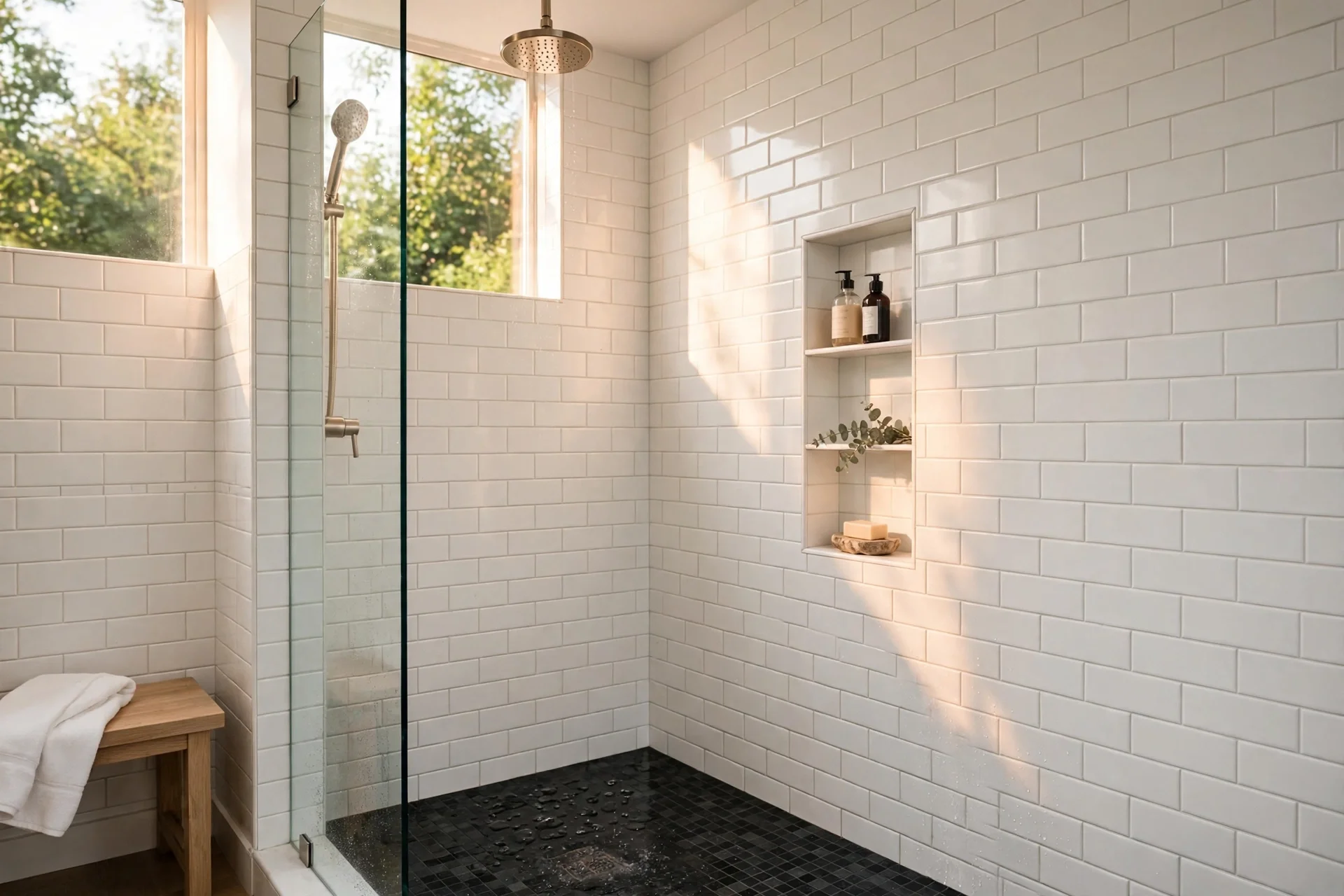
Your Custom Tile Shower in One Week: What Happens Each Day
Your custom tile shower takes about one week to build. Here is what happens each day, so you know what to expect.
Before Day One: Plan and Order Materials
Before day one, we plan the shower and lock in the tile, layout, niche, bench, fixtures and drain, and order the materials.
Day One: Demo and Prep
Day one is demo and prep. We take the old shower out, open the walls, and check the subfloor and framing. We fix everything we find before any tile goes in.
Day Two: Plumbing and Waterproofing
Day two is plumbing and waterproofing. We set the drain and valve, then waterproof the shower from floor to ceiling, including the seams and corners.
Days Three and Four: Tile
Days three and four are for tile. We tile the walls first, then the floor, setting the tile straight, spacing it evenly, and cutting it cleanly around the niche, valve and drain.
Day Five: Grout and Finish
Day five is grout and finish. We grout the tile, clean it, seal it, set the fixtures, and put the glass panel in last.
Days Six and Seven: Cure, Check and Clean
Days six and seven are for curing, checking and cleaning. We walk the shower with the homeowner, test everything, and clean up.
What Can Stretch the Week
A few things can stretch the week:
Hidden water damage
Special-order tile or fixtures arriving late
Changes mid-build
How Much Does a Custom Tile Shower Cost in Evansville?
Most custom tile showers in Evansville run $7,000 to $8,000, including demolition, waterproofing, tile, grout, fixtures and glass.
Get a Free Estimate
Call River City Flooring Pros at (812) 454-1631 for a free estimate.
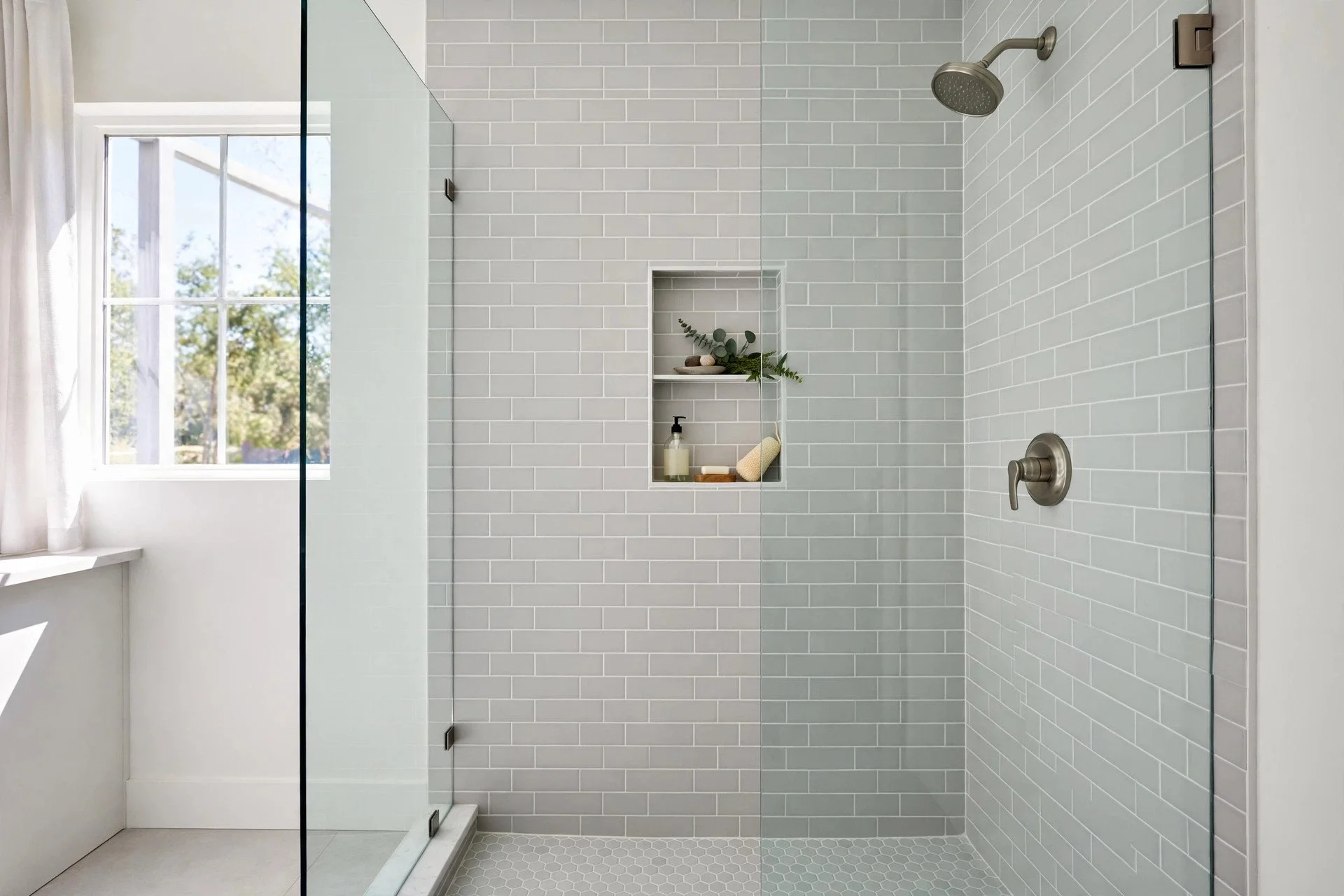
How to Care for Your New Custom Tile Shower (So It Looks New for Decades)
Your new custom tile shower is finished, the glass is in, and the grout has cured. It looks great — and with a little regular care, it will look that good for decades.
A tile shower is not like a fiberglass unit you can scrub with anything and forget about. The tile is tough, but the grout lines, the sealant, and the glass need a gentle routine. None of it is hard. Here is what we tell every Evansville homeowner after we finish their shower.
THE WEEKLY ROUTINE: FIVE MINUTES
You do not need a deep clean every week. You need a quick one.
- Squeegee the glass and walls after your shower. Thirty seconds with a squeegee keeps water spots and soap film from building up. It is the single best habit for a tile shower.
- Wipe down the fixtures. A quick pass with a soft cloth keeps hard-water spots off the showerhead and valve trim.
- Rinse the shower floor. A fast rinse sends loose hair and soap down the drain before it settles into the grout.
That is it. Five minutes a week, and your shower stays ahead of the buildup instead of behind it.
CLEANING THE TILE AND GROUT
Use a pH-neutral cleaner — the kind labeled safe for tile and stone. Spray it on, let it sit for a few minutes, and wipe or scrub lightly with a soft brush or sponge.
A few things to avoid:
- No bleach, no vinegar, and no harsh acid cleaners on a regular basis. They can wear down grout and damage sealant over time.
- No abrasive pads or steel wool. They scratch tile glaze and rough up grout, which makes it stain faster.
- No bar soap with heavy oils. Liquid body wash rinses cleaner and leaves less soap scum on tile and glass.
If a grout line starts to look dingy, a paste of baking soda and water, worked in with an old toothbrush, usually brings it back. For stubborn spots, a grout-safe cleaner from a tile shop works better than anything from the bleach aisle.
SEALING: THE ONE JOB YOU CANNOT SKIP
Grout is porous. That is why it gets sealed — and why it needs to be sealed again from time to time.
- When: About once a year for most showers, or sooner if water stops beading on the grout lines.
- How: A penetrating grout sealer, applied to clean, dry grout. It soaks in and dries clear.
- Natural stone tile: If your shower uses marble or another natural stone, the tile itself needs sealing too, on the same schedule.
The test is simple: sprinkle a little water on a grout line. If it beads up, the seal is good. If it soaks in and darkens the grout, it is time to reseal.
KEEPING THE GLASS CLEAR
Glass panels and doors show water spots more than anything else in the shower. Two habits keep them clear:
- Squeegee after every shower. This matters more for glass than for tile.
- Use a daily shower spray if you like — a light, no-rinse spray after showering slows soap scum between weekly cleanings.
If hard-water spots have already set in, a paste of baking soda and water on a soft cloth usually lifts them. For heavy buildup, a cleaner made for shower glass works well. Never use a razor blade or abrasive pad on glass.
WATCH THE CAULK LINES
The caulk where the tile meets the tub or shower pan, and in the corners, is a wear item. It flexes with the house, and it will eventually shrink or crack.
Check the caulk lines every few months. If you see gaps, peeling, or dark spots that will not clean off, it is time to replace that bead of caulk. It is a small job — scrape out the old bead, clean the joint, and lay a new bead of silicone caulk made for bathrooms. Left alone, a failed caulk line lets water get behind the tile, which is exactly the problem a well-built shower is designed to prevent.
VENTILATION MATTERS MORE THAN YOU THINK
The best cleaning routine in the world will not save a shower in a bathroom that never dries out.
- Run the exhaust fan during every shower and leave it on for 20–30 minutes after. If your fan is old and weak, replacing it is one of the cheapest upgrades you can make.
- Leave the shower door or curtain partly open after showering so air can circulate.
- Keep the bathroom door open when the room is not in use, if privacy allows.
Good airflow keeps grout dry, keeps mildew from getting a foothold, and keeps your new shower looking new.
WHAT ABOUT THE DRAIN?
Hair is the enemy of every shower drain. A simple drain screen — a flat mesh or silicone cover that sits over the drain — catches most of it before it goes down the pipe. Empty it after each shower and you will rarely need a plunger or a drain cleaner.
If the drain does slow down, a drain snake or a manual hair remover works. Avoid pouring chemical drain cleaners into a tile shower on a regular basis; they are hard on pipes and on the finishes around the drain.
WHEN TO CALL A PROFESSIONAL
Most shower care is do-it-yourself. But call a pro if you notice any of these:
- A grout line that stays dark or damp long after the shower dries — it may mean water is getting behind the tile.
- Loose or cracked tiles, or grout that is crumbling out of the joints.
- A musty smell that will not go away, even after cleaning and ventilating.
- Water pooling on the shower floor instead of running to the drain.
Caught early, these are small repairs. Caught late, they are the start of a rebuild.
THE PAYOFF
A custom tile shower is built to last 25 years or more. The difference between a shower that looks tired after five years and one that still looks new after twenty is not luck — it is five minutes a week, the right cleaner, a yearly seal, and a fan that actually runs.
Take care of the shower, and it takes care of you — every morning, for decades.
THINKING ABOUT A CUSTOM TILE SHOWER?
If you are still showering in an old tub or a tired fiberglass unit, a custom tile shower is a one-week project that changes your bathroom completely. River City Flooring Pros builds custom tile showers in Evansville, IN — typically $7,000–$8,000, about one week from tear-out to finished glass.
Call (812) 454-1631 for a free estimate. We will measure your space, talk through tile and layout options, and give you a firm number — no pressure, no obligation.
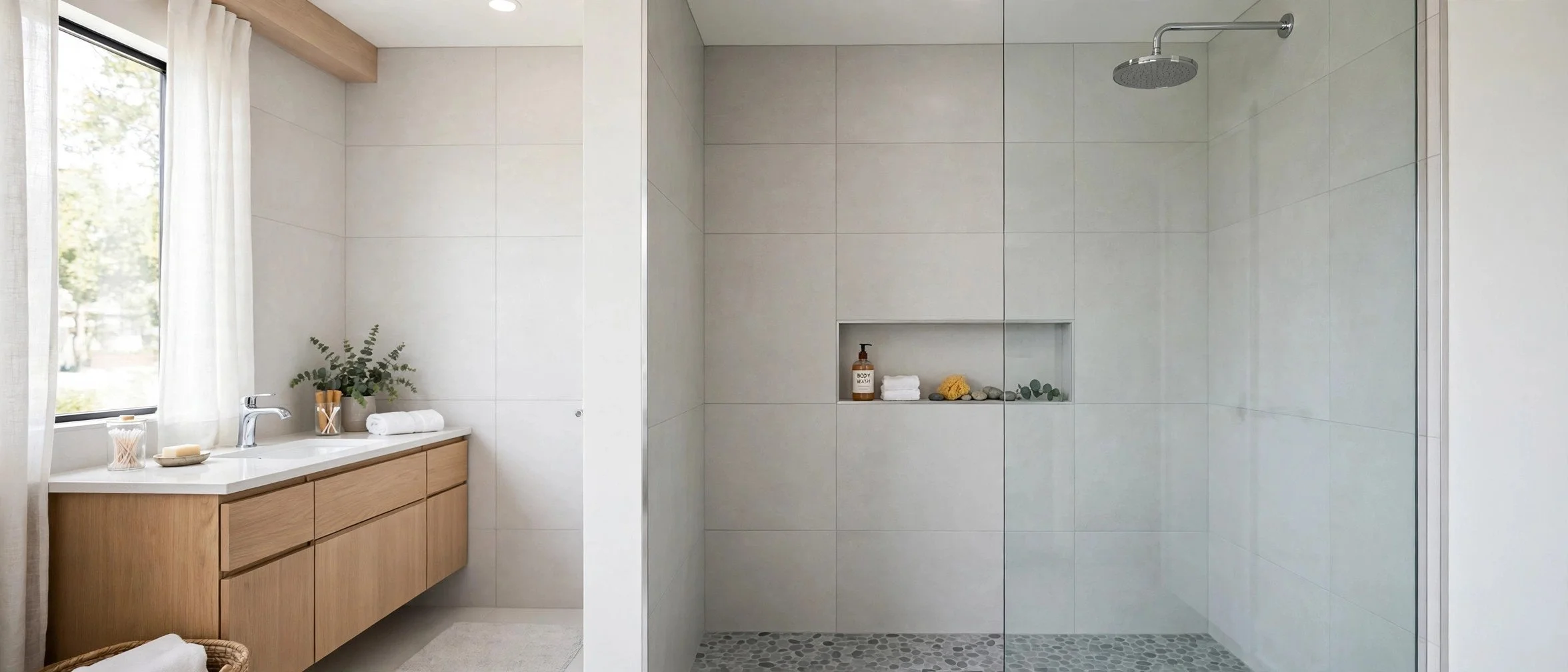
How Much Does a Custom Tile Shower Cost in Evansville, IN? (2026 Guide)
If you are thinking about replacing your old tub or tired fiberglass shower with a custom tile shower, the first question is always the same: what is this going to cost, and how long will my bathroom be torn up? Here is the straight answer for Evansville, Indiana.
THE SHORT ANSWER
A custom tile shower from River City Flooring Pros typically costs $7,000–$8,000 and takes about one week to build, start to finish. That is the full job — tear-out of the old shower, waterproofing, tile, grout, glass, and fixtures — built to last for decades, not a quick cover-up that looks good for a year and then starts leaking.
WHAT IS INCLUDED IN THAT PRICE
When we quote a custom tile shower, the price covers the whole job, not just the tile you see:
- Tear-out and haul-away. Your old tub or shower comes out, and the mess leaves with us.
- Waterproofing. A continuous waterproof membrane across the floor and up the walls, with sealed seams and corners. This is the part you never see — and the part that decides whether your shower lasts five years or twenty-five.
- Tile and grout. Wall tile, shower floor tile, and grout, installed with level lines and tight, even joints.
- Shower pan and drain. A properly sloped base so water runs to the drain and never pools in a corner.
- Fixtures. Shower valve, showerhead, and trim, installed and tested.
- Glass. A fixed glass panel or door, fitted to your shower once the tile is in.
- Cleanup. We leave your bathroom clean. A remodel should not feel like a construction site when we are done.
WHAT MOVES THE PRICE UP OR DOWN
Most custom tile showers land in that $7,000–$8,000 range, but a few choices can move the number:
- Size. A standard 36-by-48-inch shower costs less than a large walk-in. More square feet means more tile, more waterproofing, and more labor.
- Tile choice. Porcelain and ceramic tile are the workhorses — durable, easy to clean, and fairly priced. Natural stone like marble looks beautiful but costs more per square foot and needs regular sealing. Large-format tile can save on grout lines but takes more skill to set flat.
- Niches and benches. A built-in niche for shampoo and a tiled bench are the two most popular upgrades. They add a modest amount to the price and a lot to how the shower feels every day.
- Curb-less entry. A zero-entry shower with no step to climb over takes careful floor work so water drains perfectly. It costs a little more and is worth it if you are remodeling for the long term.
- Fixtures. A standard showerhead and valve keep the price where it is. A rainfall head, a handheld sprayer, or a second showerhead adds cost — and comfort.
- What we find behind the walls. Old showers sometimes hide rotted studs or a damaged subfloor. We cannot see it until the old shower comes out. If we find damage, we fix it properly and tell you what it costs before we do the work. No surprises.
THE ONE-WEEK TIMELINE
Here is what a typical week looks like:
- Day 1: Tear-out. The old shower comes out. We inspect the framing and subfloor underneath.
- Days 2–3: Waterproofing and prep. The shower pan is built and sloped, the membrane goes on, and everything is sealed and tested.
- Days 4–5: Tile. Wall tile and floor tile go in, then cure.
- Day 6: Grout and fixtures. Grout goes in, fixtures are installed, and everything is tested.
- Day 7: Glass and finish. The glass panel or door is fitted, caulk and sealant go on, and we clean up.
You are without that one shower for about a week. If you have a second bathroom, life goes on as normal. If you do not, we will talk through the timing before we start so you can plan around it.
WHY A CUSTOM TILE SHOWER IS WORTH IT
A fiberglass shower is a box. A custom tile shower is built for your bathroom, your height, your habits, and your taste. The tile you pick, the niche where it goes, the bench if you want one — it is yours, not a factory mold.
It also adds real value to your home. A well-built tile shower is one of the first things buyers notice in a bathroom, and one of the things that makes a house feel cared for.
And unlike a cheap remodel, a properly waterproofed tile shower does not come back to haunt you. No leaks into the ceiling below. No mold behind the wall. No redo in five years.
GET A FREE ESTIMATE
Every bathroom is different, so the best way to know your exact price is a free in-home estimate. We measure your space, talk through tile and layout options, and give you a firm number — no pressure, no obligation.
Call River City Flooring Pros at (812) 454-1631 to schedule your free estimate for a custom tile shower in Evansville, IN. One week, $7,000–$8,000, and a shower you will love every morning.
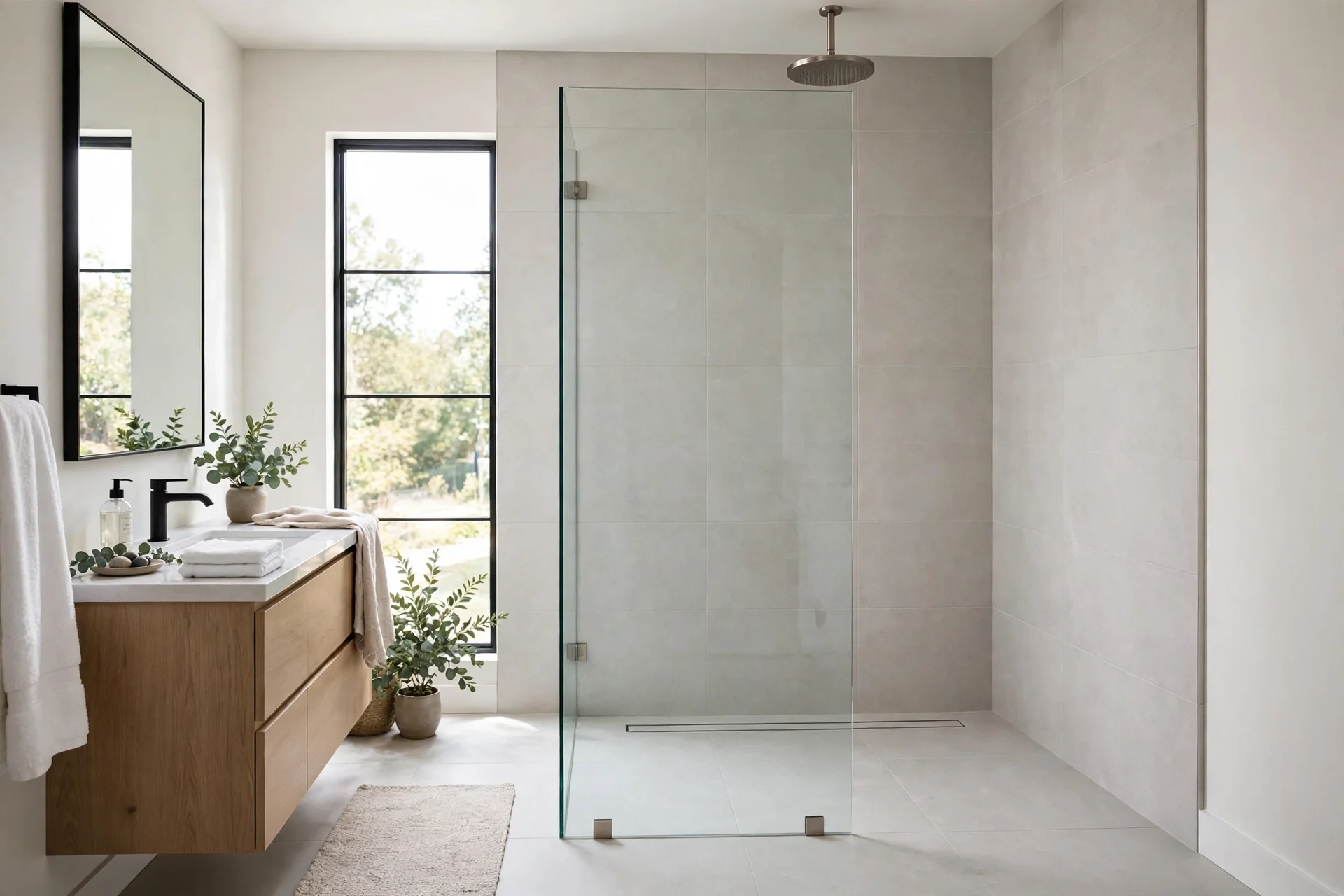
Curb-Less Walk-In Tile Showers: No Step, No Threshold, No Hassle
If you have ever stepped over a shower curb with wet feet, or watched an older parent struggle to get in and out of the tub, you already understand the appeal of a curb-less shower. There is no step. No threshold to trip on. You just walk in.
A curb-less walk-in tile shower is one of the most popular upgrades we build at River City Flooring Pros in Evansville, Indiana. It looks modern, it is safer and easier to use, and it makes even a small bathroom feel bigger. Here is what it is, how it works, and what it costs.
What Is a Curb-Less Shower?
A standard shower has a curb — a raised lip, usually 4 to 6 inches high, that keeps water inside the shower. A curb-less shower has no lip at all. The bathroom floor flows straight into the shower floor, with a gentle slope that carries the water to the drain.
Instead of a curb holding the water back, the design does the work. The shower floor is sloped toward the drain, and the rest of the bathroom floor is graded slightly away from the shower. Done right, water stays where it belongs and the floor outside the shower stays dry.
Most curb-less showers use a linear drain — a long, narrow drain set along the back wall or at the entrance — instead of a small round drain in the middle. A linear drain lets the floor slope in one direction, which is simpler, drains faster, and works beautifully with large-format tile.
Why Homeowners Love Them
No step to climb over. This is the big one. A curb-less entry is easier for everyone: kids, older family members, anyone with a bad knee or a sore back, and anyone using a walker or a wheelchair. It is also just easier on a normal morning when you are half awake and stepping in with wet feet.
A bathroom that feels bigger. Without a curb and a shower door track breaking up the room, the eye sees one continuous floor. A small bathroom can feel noticeably larger. A glass panel instead of a full door keeps the open feeling going.
Easy to clean. Fewer edges, no curb to scrub around, no door track collecting soap scum. You can mop straight across the floor and into the shower. A squeegee after each shower and a weekly wipe-down is all most curb-less showers need.
It looks like a high-end hotel. There is a reason curb-less showers show up in spa bathrooms and new hotels. The clean lines, the big tile, and the open entry read as modern and finished. It is one of the few upgrades that changes how the whole bathroom feels.
The Drainage Has to Be Right
A curb-less shower is not just a regular shower with the curb left out. The slope is everything. If the floor does not pitch correctly toward the drain, water will wander out onto the bathroom floor.
Here is how we handle it:
One-direction slope. With a linear drain along the back wall, the whole shower floor slopes gently in a single direction. That is easier to build correctly than sloping four ways toward a center drain, and it drains faster.
Waterproofing under everything. The shower floor, the walls, and the bathroom floor around the shower are all part of the same waterproofing system. There is no weak spot where water can slip through to the subfloor.
The right tile. Large-format tile works well on a single-slope floor. For extra grip, many homeowners choose a textured or matte tile on the shower floor, or smaller mosaic tile, which gives your feet more traction.
A glass panel, not a curtain. A fixed frameless glass panel keeps the spray in without closing off the room. It also means there is no door track on the floor to clean or trip over.
Getting this right takes experience. A curb-less shower is one of those jobs where the details under the tile matter more than the tile itself, and that is exactly the part we spend the most time on.
What About the Rest of the Bathroom?
Because there is no curb, the bathroom floor outside the shower needs to be part of the plan. We usually recommend tile throughout the bathroom, so the floor is one continuous waterproof surface. If the rest of the bathroom has a different floor, we plan the transition carefully so water still has nowhere to go but the drain.
This is also a good time to think about the layout. A curb-less shower works best when the showerhead is on the far wall from the entrance, so the spray is aimed away from the opening. A rain showerhead or a handheld on a slide bar both work well, and a built-in niche keeps your bottles out of the spray.
Cost and Timeline
A curb-less walk-in tile shower from River City Flooring Pros typically runs $7,000 to $8,000 for the complete job — waterproofing, tile, linear drain, glass panel, fixtures, and labor — finished in about a week.
That is the same one-week, all-in price as our other custom tile showers. Going curb-less does not add weeks to the job or double the price. The linear drain and the extra floor work are part of the quote up front, so there are no surprises halfway through.
If you are remodeling a whole bathroom, a curb-less shower is also one of the smartest places to spend the money. It is the feature you will use every single day, and it is the one future buyers notice first.
Is a Curb-Less Shower Right for Your Home?
A curb-less shower works in most Evansville homes, including older ones, but it does need enough room to get the slope right and a subfloor that can be adjusted. On a concrete slab, that usually means building the bathroom floor up slightly outside the shower. On a wood subfloor, it can mean recessing the shower floor between the joists. We check all of that during the free estimate, before any work starts, so you know exactly what your bathroom needs.
It is also worth thinking about the long term. A curb-less shower is the easiest shower to use at any age. If you plan to stay in your home for years, it is one of the best aging-in-place upgrades you can make — and unlike a grab bar bolted to the wall later, it looks like a design choice, not a compromise.
Ready to Walk In?
If you are planning a custom tile shower in Evansville, ask us about going curb-less. No step, no threshold, no hassle — just a beautiful open shower that is easier to use and easier to clean.
Call River City Flooring Pros at (812) 454-1631 for a free estimate on your curb-less walk-in tile shower in Evansville, IN. One week, $7,000–$8,000, and a shower you can walk straight into.
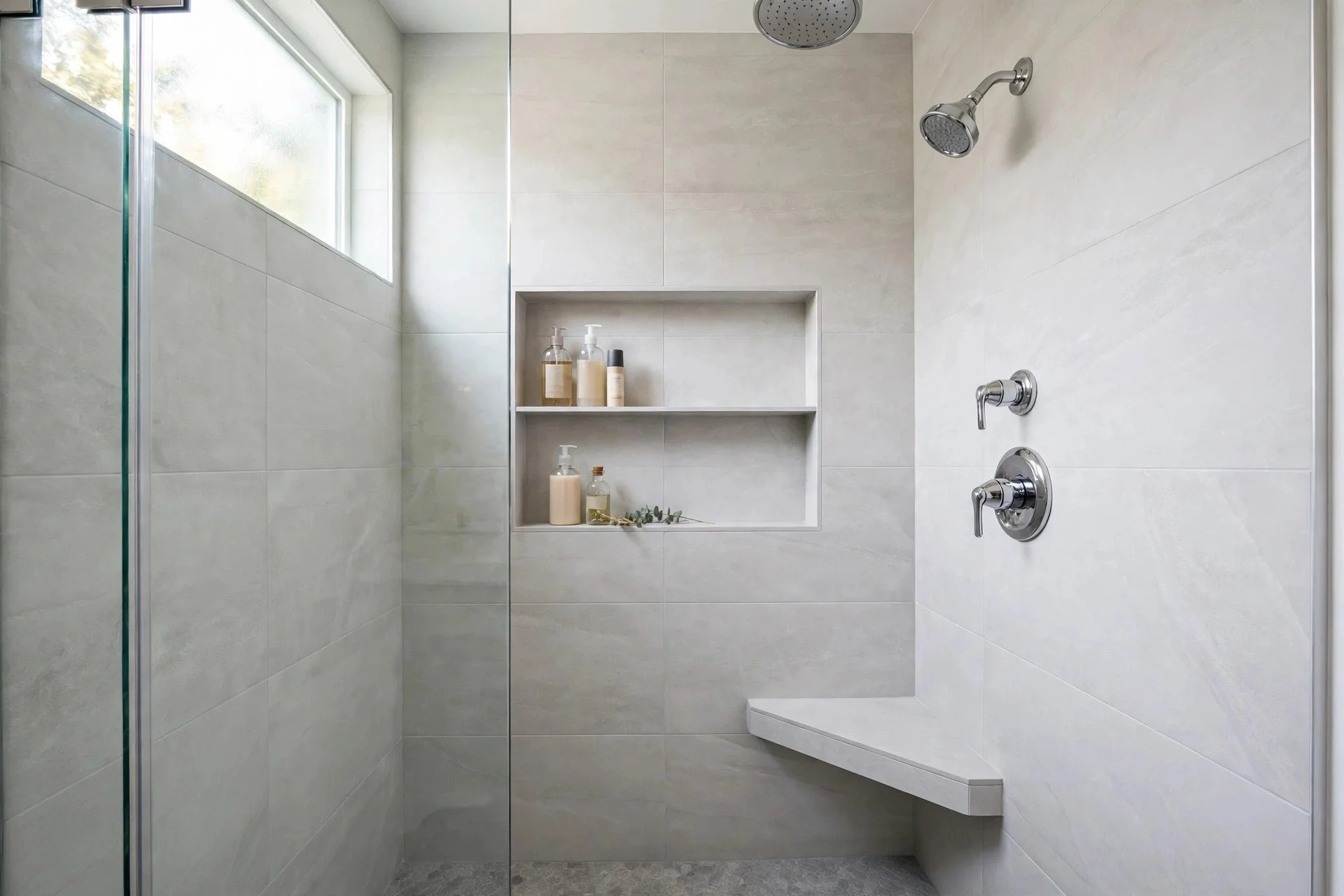
Built-In Niches and Benches: The Small Details That Make a Custom Tile Shower Feel Finished
The difference between a plain shower and a shower you love every morning is often in the details you barely notice — until they are missing. A built-in niche keeps your shampoo off the floor. A bench gives you a place to sit, shave, or just stand under the hot water for an extra minute. These are small features, but they change how a shower feels to use.
At River City Flooring Pros, we build custom tile showers in Evansville, Indiana, and niches and benches are two of the most popular upgrades our customers ask for. Here is how they work, what they cost, and how to get them right.
What Is a Shower Niche?
A niche is a recessed shelf built right into the shower wall. Instead of a wire rack hanging from the showerhead or a plastic caddy that rusts and slides around, your bottles sit in a tiled shelf that is part of the wall itself.
A standard niche is about 12 inches wide and 24 inches tall, with one shelf in the middle — enough for shampoo, conditioner, body wash, and a razor. Bigger showers can take a taller niche with two shelves, or a wide horizontal niche that runs along the wall like a ledge. We tile the inside of the niche to match the shower, so it looks like it was always meant to be there.
The key to a good niche is placement. It should be easy to reach from where you stand, but out of the direct spray of the showerhead so your bottles are not sitting under running water. We plan the location with you before we build, so it ends up exactly where your hand expects it.
What Is a Shower Bench?
A shower bench is a built-in seat, tiled to match the rest of the shower. It can run along one wall, tuck into a corner, or float as a small ledge just big enough to sit on.
Benches are useful for more reasons than people expect. They make shaving your legs easy. They give you a place to rest if standing for a long shower is hard on your knees or back. They are a safe, steady seat for older family members or anyone recovering from an injury. And on a cold morning, sitting under hot water for a few extra minutes is one of life's small pleasures.
A bench also makes a shower feel like a real room instead of a box you stand in. It is one of the features that turns a shower from functional into something you actually enjoy.
Built In Beats Bolted On
You can buy a plastic corner shelf or a teak bench and set it in any shower. But bolted-on accessories have a habit of coming loose, collecting mildew behind them, and looking like an afterthought.
A built-in niche or bench is different. It is framed, waterproofed, and tiled as part of the shower itself. Water drains off it the same way it drains off the walls and floor. There are no screws through the tile, no brackets to rust, and nothing to clean behind. Done right, it lasts as long as the shower does — which, with proper waterproofing, is decades.
This is one of the reasons a custom tile shower is worth building properly the first time. The niche and bench are not extras glued on at the end. They are part of the structure, planned before the first tile goes up.
Designing Niches and Benches for Your Shower
A few practical choices make the difference between a niche or bench you love and one you never use:
Height matters. A niche should sit at chest height, where you can reach it without stretching or bending. A bench should be about 17 to 19 inches high — standard seat height — so sitting down and standing up feel natural.
Slope the shelves. Niche shelves and bench tops get a slight slope toward the shower, so water runs off instead of pooling. Standing water is what causes soap scum and mildew, and a small slope prevents it.
Pick the right tile. A contrasting mosaic inside the niche makes a beautiful accent. A bench top in the same large-format tile as the walls keeps the look clean and simple. Either way, we help you choose a tile that grips well and is easy to wipe down.
Think about the future. A bench you add for comfort today is the same bench that makes the shower safer and easier to use years from now. It is one of the smartest features to include if you plan to stay in your home.
What Niches and Benches Add to the Cost
A niche or bench is included in the way we price a custom tile shower. Our showers typically run $7,000 to $8,000 for the complete job — waterproofing, tile, fixtures, niche, bench, and labor — finished in about a week.
That all-in price is deliberate. You should not have to decide between a shower that works and a shower that feels finished. When we quote your shower, we will talk through the niche and bench options with you up front, so the price you hear is the price for the shower you actually want.
How We Build Them
Here is the short version of how a niche and bench come together in one of our showers:
We frame it in. The niche opening and the bench structure are built into the wall framing before any waterproofing goes on.
We waterproof everything. The niche, the bench, the walls, and the floor are all sealed with the same waterproofing system, so there is no weak spot where water can get in.
We tile it to match. The niche interior and the bench top are tiled with the tile you chose, with clean edges and a slight slope for drainage.
We finish the details. Grout, caulk, and a final check that every surface drains and every edge is smooth.
The whole shower — niche, bench, tile, and all — is typically finished in about a week.
Ready for a Shower That Feels Finished?
If you are planning a custom tile shower in Evansville, think about the details that will make it yours. A niche for your bottles, a bench for your comfort, and tile you love looking at every morning — that is what turns a bathroom project into a shower you will enjoy for years.
Call River City Flooring Pros at (812) 454-1631 for a free estimate on your custom tile shower in Evansville, IN. One week, $7,000–$8,000, and a shower built around the way you actually use it.
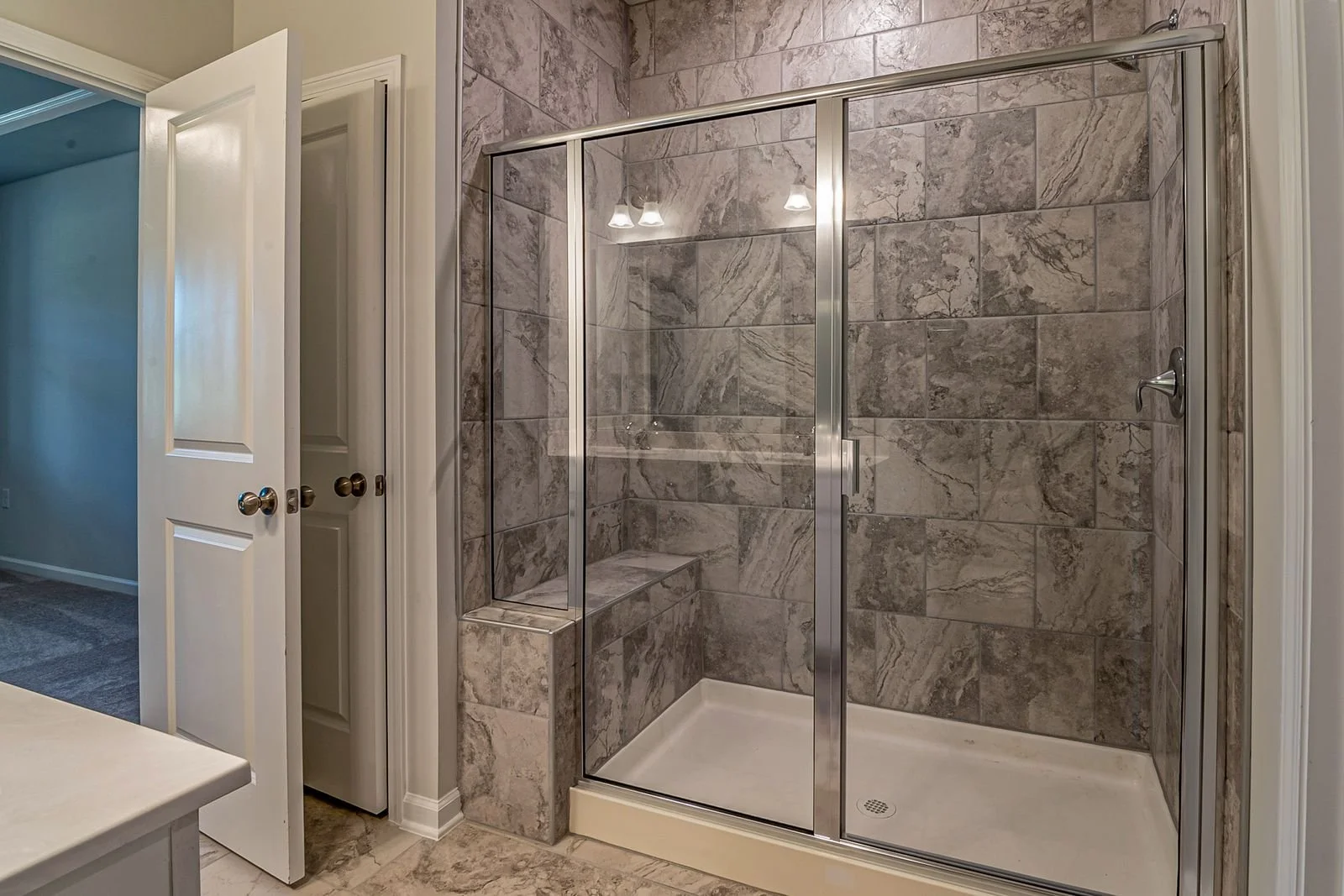
Choosing the Right Tile For Your Custom Shower in Evansville
The tile you choose sets the whole feeling of your shower. It decides how the room looks, how the floor feels under your feet, and how much cleaning you will do for the next twenty years. The good news is that there is no single "best" tile — there is a best tile for your shower, your budget, and your habits.
At River City Flooring Pros, we build custom tile showers in Evansville, Indiana. Here is how we help homeowners pick tile with confidence.
Porcelain Tile: The Workhorse
Porcelain is the tile we recommend most often, and for good reason. It is dense, hard, and absorbs almost no water, which is exactly what a shower needs. It comes in every look imaginable — including convincing copies of marble, concrete, and wood — at a price most budgets can live with.
Porcelain is easy to clean, holds up to daily use, and does not need sealing the way natural stone does. If you want a beautiful shower without a lot of upkeep, porcelain is hard to beat.
Marble and Natural Stone: The Showpiece
Real marble is stunning. No printed tile copies the depth and veining of the real thing, and in a shower it turns an everyday room into something special. Limestone and travertine offer a softer, warmer look for the same reason.
Natural stone does ask more of you. It needs to be sealed when it goes in and resealed on a regular schedule, and it can stain if a harsh cleaner sits on it too long. If you love the look and do not mind the upkeep, it is worth every penny. If low maintenance matters more, porcelain that looks like marble gives you the same feeling with far less care.
Mosaic Tile: Small Tiles, Big Character
Mosaic tile — small pieces on a mesh sheet — is the classic choice for shower floors. The extra grout lines give your feet grip, which matters on a wet floor, and the small pieces follow the slope to the drain perfectly.
Mosaics also shine as an accent: a band of color across the wall, a feature strip in the niche, or a contrasting floor against large wall tiles. A little mosaic goes a long way.
Large-Format Tile: Clean Lines, Fewer Grout Joints
Large tiles — 12 by 24 inches and bigger — are the modern favorite for shower walls. Fewer grout lines mean a cleaner look and less grout to clean. A big tile also makes a small shower feel larger, because the eye reads fewer breaks in the surface.
Large-format tile takes a skilled hand to set. The walls have to be flat and true, and each tile has to be leveled just right, or the edges will catch the light wrong. This is where an experienced installer earns the price — and it is why a custom tile shower is worth doing properly the first time.
What Tile Costs in a Custom Shower
Tile itself usually runs from a few dollars a square foot for basic porcelain to much more for premium marble or handmade tile. But the tile is only part of the price of a shower. The real cost is the build underneath it: the waterproofing, the sloped pan, the plumbing, and the skilled labor to set every tile straight and true.
That is why we price our custom tile showers as one complete job — typically $7,000 to $8,000, finished in about a week. You get the tile you picked, installed over a waterproofing system built to last, with no surprises in the middle of the job. Before we start, we will walk you through tile options at different price points so you can choose with your eyes open.
Keeping Your Tile Looking New
A tile shower stays beautiful with simple habits:
Squeegee the walls after your shower. Thirty seconds keeps water spots and soap film from building up.
Use a pH-neutral cleaner. Harsh acids and bleach wear down grout and stone sealers over time.
Reseal natural stone on schedule. If you chose marble or travertine, we will tell you when it is time to reseal — usually once a year.
Check the grout once in a while. A small crack sealed early is a five-minute fix. Left alone, it becomes a leak.
Ready to Pick Your Tile?
The best way to choose tile is to see it and touch it — and to talk through it with someone who has installed it a hundred times. That is what a free estimate is for. We will look at your bathroom, talk through your options, and give you a straight price for a custom tile shower built to last.
Call River City Flooring Pros at (812) 454-1631 for a free estimate on your custom tile shower in Evansville, IN. One week, $7,000–$8,000, and a shower you will love every morning.
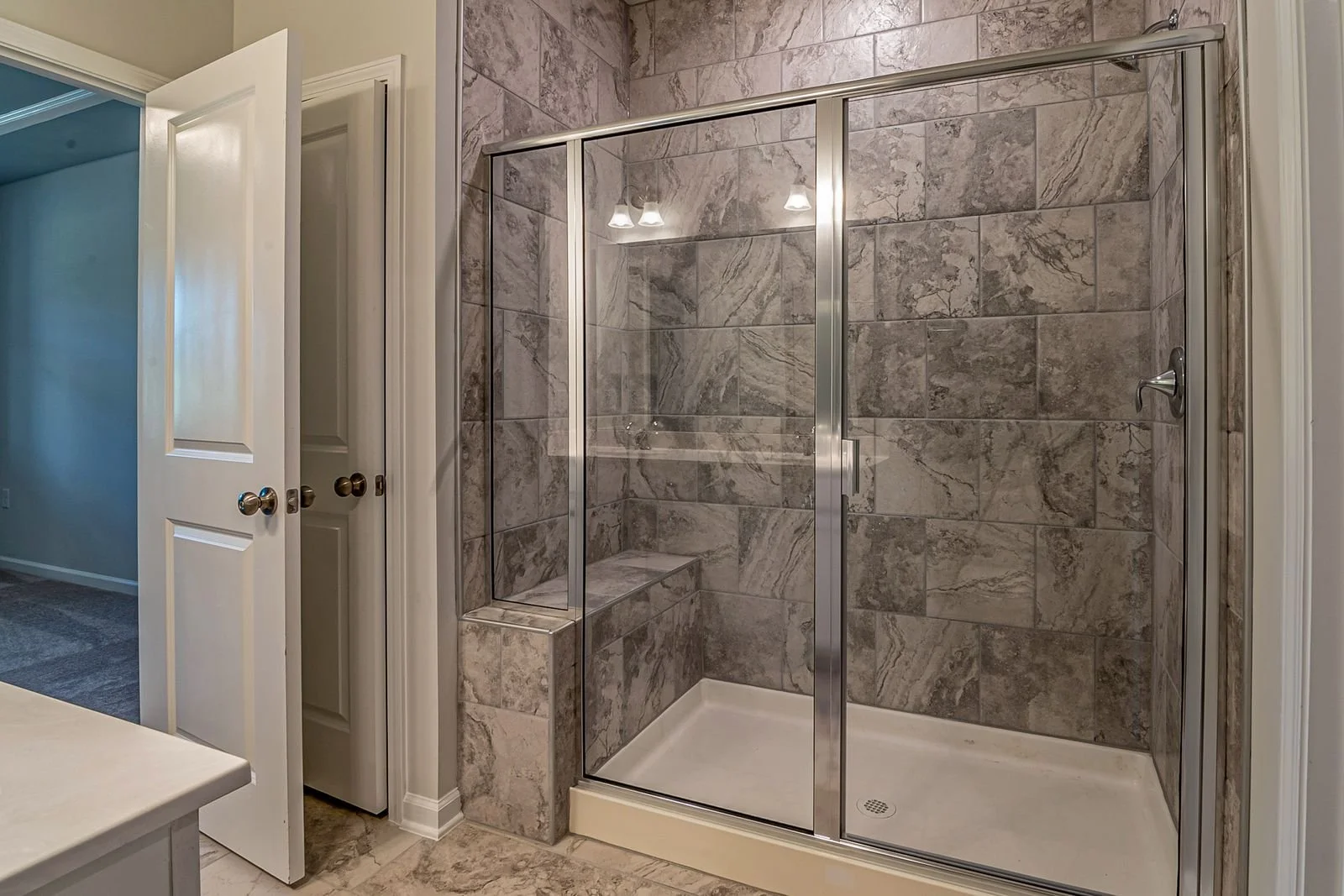
Designing Your Dream Custom Tile Shower: Layout, Niches, Benches, and Curb-less Entries
A custom tile shower is the one place in your home where good design pays you back every single morning. You step into it half asleep, and it should feel right: the water where you want it, a place for your shampoo, a bench if you want one, and tile that looks as good in ten years as it does on day one.
At River City Flooring Pros, we build custom tile showers in Evansville, Indiana — and the design choices you make before we start are what turn a good shower into your shower. Here is how to think through them.
Start With the Layout, Not the Tile
Before anyone picks a tile, we look at the space. How big is the shower? Where do the water lines come in? Where does the door or opening go? A well-planned layout makes a small shower feel generous and a big shower feel effortless.
A few layout questions we work through with every homeowner:
Walk-in or enclosed? A walk-in shower with a fixed glass panel feels open and modern. A fully enclosed shower with a door keeps steam and splashes in. Both work — it depends on your bathroom and your habits.
Where does the showerhead go? It should not spray straight at the door. A little planning here keeps cold water off you when you first step in.
How much room do you really need? A comfortable shower is at least 36 inches wide. If your bathroom allows it, 42 to 48 inches feels like a real upgrade — room to turn around, room for a bench, room to breathe.
Good layout is free. It costs nothing extra to put the valve where your hand naturally reaches or to angle a bench into the corner where it belongs. It just takes planning before the walls close up.
Curb-less Showers: The Step-Free Upgrade
A curb-less (or zero-entry) shower has no raised lip to step over — the floor flows straight in. It looks clean and modern, and it is the easiest shower to get in and out of, which matters for kids, older family members, and anyone with a bad knee.
Curb-less showers take careful work: the floor has to slope gently and precisely to the drain so water never wanders into the rest of the bathroom. Done right, they are the most comfortable showers we build. If you are remodeling for the long term, a curb-less entry is one of the smartest choices you can make.
Built-In Niches: Storage That Disappears
A recessed niche is a shelf built into the wall of the shower — tiled, waterproof, and flush with the wall. No bottles on the floor, no rusty caddy hanging from the showerhead, nothing to knock over.
Plan your niches early, because they go in while the walls are open. Think about:
Height: Eye level is right for most people. If the shower is shared, a taller niche with two shelves works for everyone.
Size: Big enough for tall shampoo bottles, with room to spare. A niche that is too small is just a decoration.
Placement: On the wall opposite the showerhead, so bottles stay dry and within reach.
One well-placed niche is usually enough. Two is a luxury. Either way, it is a small addition during a build and an expensive afterthought later.
Benches and Seats: Small Comfort, Big Difference
A built-in tiled bench turns a shower from a place you rush through into a place you enjoy. It is a spot to sit under the hot water, to shave your legs, or to rest while the steam does its work.
Benches work best in the corner opposite the showerhead, and they pair well with a handheld showerhead on a slide bar — easy rinsing, easy cleaning, and easy reach from a seated position. A corner bench or a small floating seat fits most showers without eating up standing room.
If you are planning to age in place, a bench plus a curb-less entry plus a handheld showerhead is the combination we recommend most.
Tile Choices That Set the Style
Tile is where your shower gets its personality. A few combinations our Evansville homeowners love:
Large-format porcelain on the walls — fewer grout lines, a clean modern look, and easy to wipe down.
Subway tile — classic, timeless, and it works with almost any bathroom style. Run it in a herringbone or vertical pattern for a fresh twist.
Mosaic tile on the floor — small tiles grip better underfoot and follow the slope of the shower pan. Pebble and penny-round mosaics add texture and spa character.
A feature wall or accent stripe — one wall in a bold color, a patterned tile, or a natural stone look turns the whole shower into a focal point without overwhelming the room.
Whatever style you choose, we will be honest about upkeep. Natural stone is beautiful, but it needs sealing. Glossy dark tile shows water spots. Matte porcelain hides them. The right choice is the one you will still love when you are cleaning it.
Fixtures: The Details You Touch Every Day
Fixtures are the jewelry of the shower. A rainfall showerhead, a handheld sprayer, a thermostatic valve that holds your temperature steady — these are the parts you feel every morning, so they are worth choosing well.
Our advice: put the money into the valve and the showerhead first, and match the finish to the rest of your bathroom. Matte black, brushed nickel, chrome, and oil-rubbed bronze all pair beautifully with tile — pick the one that fits your home, not the trend of the month.
What a Custom Tile Shower Costs — and How Long It Takes
A custom tile shower from River City Flooring Pros typically runs $7,000 to $8,000, and most jobs take about one week from tear-out to finished tile. That includes the full build — layout, waterproofing, tile, niches, benches, and fixtures — designed around your bathroom, not a kit from a box.
A free estimate gives you the exact number for your space. We measure, we talk through your options, and we give you a straight price before any work begins.
Your Shower, Your Way
The best custom tile shower is not the fanciest one — it is the one designed around how you actually live. A curb-less entry if you want easy access. A bench if you like to linger. A niche where your hand reaches without thinking. Tile that makes you smile when you walk in.
That is what we build: showers designed for the people who use them, built to last for decades.
If your shower is tired, cramped, or just not the shower you want anymore, we would love to take a look.
River City Flooring Pros builds custom tile showers in Evansville, IN — one-week installs, $7,000–$8,000, built to last. Call or text (812) 454-1631 for a free estimate.
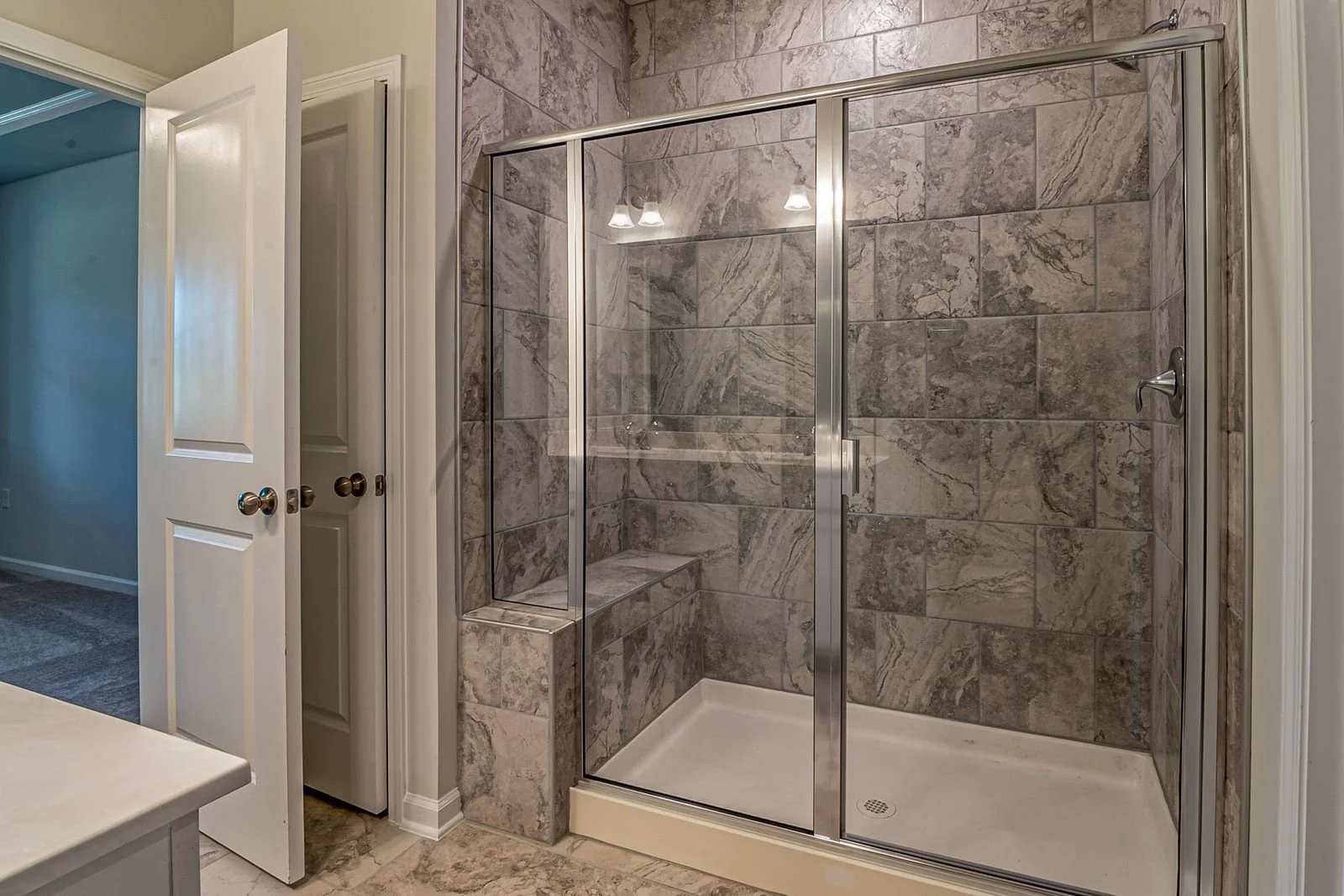
What Makes a Custom Tile Shower Last: Waterproofing Done Right
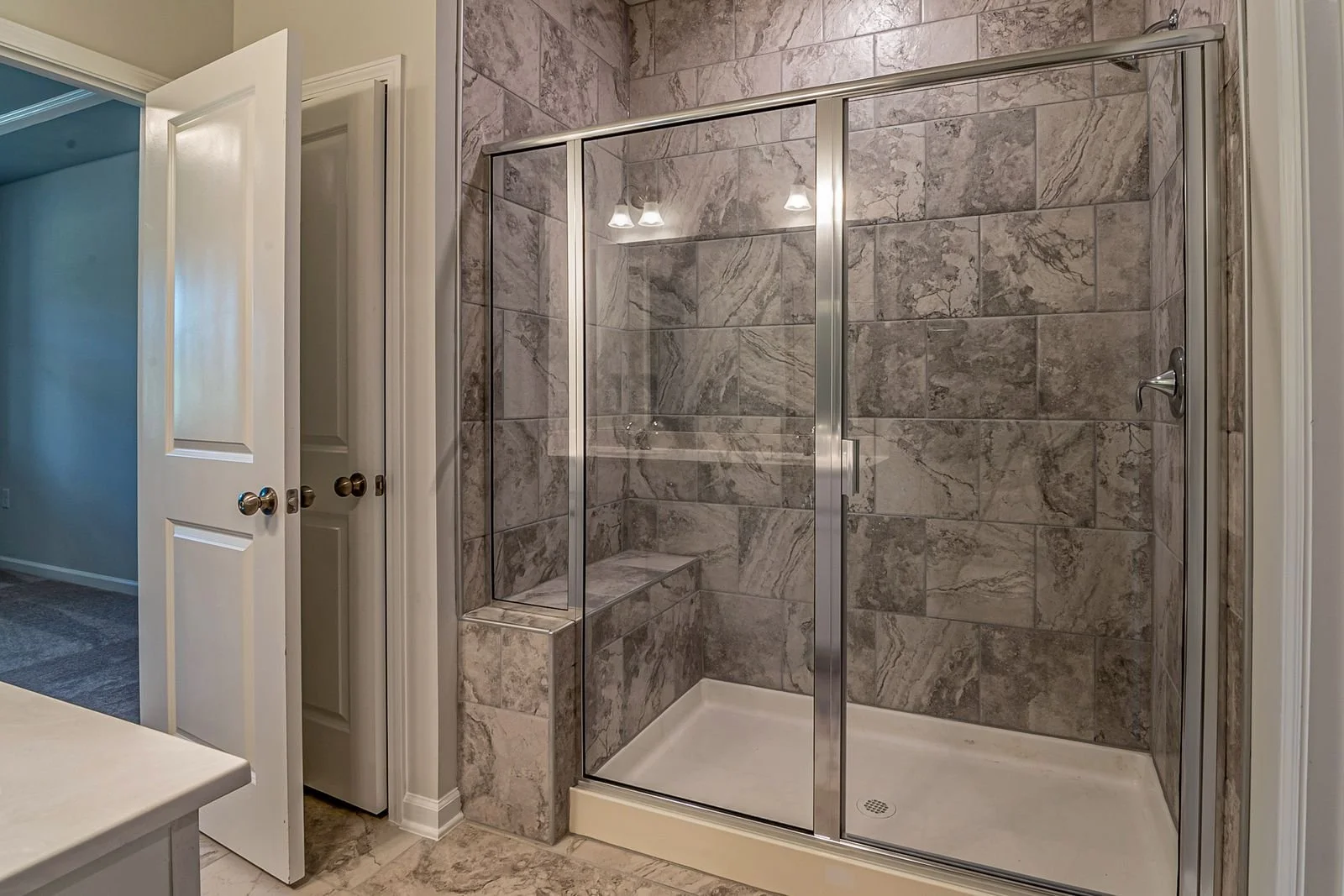
A custom tile shower should be the best part of your bathroom — and it should stay that way for decades. The tile you see is only half the job. What makes a shower last is what you never see: the waterproofing underneath it.
At River City Flooring Pros, we build custom tile showers in Evansville, Indiana, and we build every one the same way: waterproof first, beautiful second. Here is what that means, and why it matters for your home.
Why Waterproofing Is the Whole Job
Tile and grout are not waterproof. Water passes through grout lines, around corners, and down to the layers below. In a shower that gets used every day, that is a lot of water over a lot of years.
If the layers behind the tile are not sealed, water finds the studs, the subfloor, and the ceiling below. That is how showers fail — slowly, quietly, and expensively. A shower that looks fine on the surface can be rotting the wall behind it.
Proper waterproofing stops water before it ever reaches wood. That is the difference between a shower that lasts five years and one that lasts twenty-five.
How We Waterproof a Custom Tile Shower
Every shower we build follows the same careful sequence:
A solid, sloped base. The shower floor is built with the right slope so water runs to the drain, never pools in a corner. Standing water is the enemy of every shower.
A continuous waterproof membrane. We install a waterproofing membrane across the floor and up the walls, with sealed seams and corners. No gaps, no shortcuts. Corners and niches get extra attention, because that is where water likes to sneak through.
Sealed penetrations. Every place a pipe, valve, or showerhead passes through the wall is sealed. These small details are where most leaks start.
A flood test before tile goes on. Before a single tile is set, we test the pan. If it holds water, we move forward. If it does not, we fix it then — not after the tile is up and the grout is in.
Tile, grout, and sealant. Only after the waterproofing is proven do we set tile, grout the joints, and seal everything. The tile is the finish. The waterproofing is the foundation.
Signs Your Current Shower Needs Help
If your shower is more than ten years old, watch for these warning signs:
Grout that stays dark or damp long after a shower
A musty smell in the bathroom that never quite goes away
Soft spots in the wall or floor near the shower
Tiles that feel loose, or grout that keeps cracking in the same place
Stains on the ceiling of the room below the bathroom
Any one of these is worth a look. Caught early, a shower problem is a repair. Caught late, it is a rebuild — plus drywall, plus flooring, plus whatever else the water reached.
What a Custom Tile Shower Costs — and How Long It Takes
A custom tile shower from River City Flooring Pros typically runs $7,000 to $8,000, and most jobs take about one week from tear-out to finished tile. That includes the full waterproofing system, your choice of tile, niches, benches, and fixtures — built to last, not just to look good on day one.
A free estimate tells you the exact number for your bathroom. Every home is a little different, and we would rather measure your space than guess at it.
Tile Choices That Work With Waterproofing, Not Against It
The right tile makes a good waterproofing system even better:
Porcelain tile is dense, hard to stain, and a great all-around choice for walls and floors.
Large-format tile means fewer grout lines, which means fewer places for water and grime to collect.
Mosaic tile on the floor gives extra grip underfoot and follows the slope of the shower pan beautifully.
Natural stone is gorgeous, but it needs sealing — we will tell you honestly what the upkeep looks like before you choose it.
Whatever you pick, the waterproofing underneath stays the same. Good looks should never come at the cost of a dry wall.
Built-In Details Worth Having
While the walls are open is the time to add the features that make a shower a pleasure to use every day:
A recessed niche for shampoo and soap — no more bottles balanced on the floor or a rusty caddy hanging from the showerhead.
A corner bench or seat for shaving, resting, or just sitting under the hot water for an extra minute.
A handheld showerhead on a slide bar, which makes cleaning the shower — and rinsing off — much easier.
These are small additions during a build and expensive afterthoughts later. We will walk you through the options when we plan your shower.
The Bottom Line
A custom tile shower is an investment in your home and your mornings. The tile is what you see. The waterproofing is what protects you. Build both right, and you get a shower that looks beautiful and stays dry behind the walls for decades.
If your shower is tired, leaking, or just not the shower you want anymore, we would love to take a look.
River City Flooring Pros builds custom tile showers in Evansville, IN — one-week installs, $7,000–$8,000, built to last. Call or text (812) 454-1631 for a free estimate.

Don’t Get Scammed on Your Next Rental: Introducing Verified Rentals
If you have ever looked for a place to rent in Evansville, you have seen it. A nice house, a low price, pictures that look too good to be true. You send the deposit, and then the person disappears, or the house was never theirs to rent in the first place.
That is why we started a new business: Verified Rentals.
What Verified Rentals Does
Verified Rentals checks a rental before you pay for it, so you don’t get scammed.
We verify the home is real, the person listing it has the right to rent it, and what you see in the pictures is what you actually get. No fake listings. No stolen photos. No deposit sent to a stranger who vanishes.
Who It’s For
If you are looking for a house or apartment to rent in Evansville and the tri-state, and you want to know it's legit before you hand over money, Verified Rentals is for you.
Why We Started It
At River City Flooring Pros, we are in people's homes every day. We hear the stories. People lose hundreds, sometimes thousands, to rental scams. A deposit, first month's rent, an application fee, gone. And there is almost no way to get it back.
We thought there should be a simple check first. Get the rental verified, then pay with confidence.
How It Works
You find a rental you like.
Verified Rentals checks it.
You get a clear answer: verified, or walk away.
Simple as that. Don’t get got.
Verified Rentals is a new business from the team at River City Flooring Pros, Evansville, Indiana. Questions? Call or text (812) 454-1631.
The Skilled Labor Shortage: What It Means for Your Flooring Renovation Budget
The skilled labor shortage hitting the construction industry is very real — experts say we need nearly 500,000 new workers in 2026 just to keep up. Flooring installation is one of the trades feeling it the hardest. Fewer young people are entering the field, and many experienced installers are retiring. That leaves fewer qualified crews available, especially for quality work in high-traffic commercial and multi-family spaces.
For homeowners and property managers in Evansville, Indiana, this directly hits your wallet. With fewer skilled flooring installers around, lead times stretch longer and labor rates climb. Projects that used to get booked quickly now face delays, and those delays cost you — whether it's through higher hourly rates or rushed jobs that lead to callbacks later.
At River City Flooring Pros, we've been installing LVT, luxury vinyl plank, ceramic tile, and other durable flooring solutions for over 30 years. We specialize in commercial and multi-family properties right here in Evansville. While the shortage affects everyone, our experienced team and commitment to training the next generation of installers help us deliver reliable timelines and quality workmanship that protects your renovation budget.
How the shortage affects your flooring project budget:
Higher installation costs — Limited skilled crews mean premium pricing for experienced work.
Longer wait times — Good installers get booked up fast, especially for tile and LVT jobs.
Risk of lower quality — Some companies rush with less experienced help, leading to issues that cost more to fix later.
When you're searching for the best flooring installers around Evansville, Indiana, or need trusted flooring Evansville IN professionals who actually know what they're doing, experience matters more than ever. Choosing a proven local team like River City Flooring Pros helps you avoid the hidden costs that come with the skilled labor shortage.
Want to protect your renovation budget? Contact us early — the sooner we get your project on the schedule, the better we can lock in fair pricing and quality results.
Small drips over time cause big problems
Small Drips Can Cause Big Problems Later
Look closely at that photo. The tile and vinyl are gone. The plywood subfloor — the structural layer that everything rests on — is dark, swollen, and crumbling around the base of the toilet. What you’re seeing isn’t the result of a burst pipe or a major flood. This damage was done by nothing more dramatic than a slow drip, day after day, from a faulty wax ring.
Wax rings are the unsung heroes of every bathroom. Sandwiched between the base of your toilet and the drain flange in the floor, a wax ring creates a watertight seal that keeps sewer gas in the pipes and wastewater out of your home. Most of them last for years without a second thought. But when they fail — and they do fail — the consequences can quietly eat through your floor before you ever realize something is wrong.
By the time you can see the damage on the surface, the subfloor has often been compromised for months. Evansville homeowners are especially vulnerable because our hot, humid summers and cold winters put constant stress on bathroom seals and floor structures. That cycle of expansion and contraction can cause a wax ring to shift or break down gradually, sending a small amount of wastewater trickling beneath your floor with every single flush.
The warning signs are easy to miss. A soft or spongy feeling near the base of the toilet, a faint musty odor, slight rocking when you sit down, or discoloration around the toilet base are all red flags. By the time the flooring is pulled up, the damage is often far worse than expected — as you can see in the photo above, where the plywood had to be cut back well beyond the toilet footprint before solid wood was reached.
The right repair means addressing both problems together. The wax ring needs to be replaced by a plumber, and the subfloor needs to be properly cut out, dried, and rebuilt before any new flooring goes down. Laying new tile or vinyl over damaged wood is a shortcut that always fails — usually sooner than you’d think.
That’s exactly the kind of work we do at RiverCity Flooring Pros, Evansville’s best flooring installer. Whether you need a full bathroom floor replacement, subfloor repair, or just an honest look at what’s going on under your feet, our team has the local experience to get it done right. We proudly serve Evansville and the surrounding Tri-State area, including Newburgh, Boonville, and Henderson.
Don’t wait on a small problem until it becomes a big one. If something doesn’t feel right about your bathroom floor, give RiverCity Flooring Pros a call. A quick inspection today can save you a major renovation tomorrow.

The day of installation the weather turns bleak! What to do to be ready.
Installing new flooring is one of the best ways to refresh your home, adding comfort, style, and value—especially with cozy carpet during those chilly Indiana winters. But when snow, ice, sleet, or heavy rain hits Evansville, it can bring extra challenges like tracked-in mud, salt, and moisture. As the best flooring installer in Evansville, Indiana, River City Flooring Pros knows how to handle Tri-State weather like pros. With our expert team, you can ensure a seamless installation even on the stormiest days.
Here’s your complete guide to preparing for carpet installation, hardwood, LVT, or tile during poor weather conditions. These tips will protect your home, keep things clean, and help our professional installers work efficiently.
1. Create a Clean, Dry Entry Path
Our installers carry heavy rolls of carpet, padding, and tools in and out—wet boots can quickly create slips and messes.
• Lay down heavy-duty mats, tarps, or plastic runners from the door to the work area.
• Place a boot tray or absorbent mats right at the entrance to catch melting snow and mud.
• Provide old towels for quick wipe-downs—we appreciate the help keeping your floors pristine!
2. Protect Your Floors and Home from Tracked-In Grime
Evansville winters mean road salt and slush, which can stain or damage surfaces.
• Use drop cloths or rosin paper in high-traffic areas.
• Ask everyone (including our team) to remove shoes or use boot covers—we always come prepared.
• Stock extra towels near the door for puddles.
3. Maintain Ideal Indoor Conditions
Moisture and cold air can affect materials like carpet stretching or adhesive bonding.
• Keep your thermostat at 65–80°F.
• Run a dehumidifier to control humidity (aim for 35–55%).
• Avoid opening windows on rainy days.
4. Essential Pre-Installation Steps (Rain or Shine!)
• Clear rooms completely: Move furniture and breakables.
• Vacuum the subfloor thoroughly.
• Communicate the weather forecast with us—we’re Evansville locals and ready for Indiana’s unpredictable seasons.
After Installation: Protect Your New Floors
Wipe up any moisture immediately, keep entry mats in place, and follow our care instructions for perfect settling.
At River City Flooring Pros (rivercityflooringpros.com), we’re Evansville’s trusted choice for professional flooring installation, including carpet, pad, removal, and more. With years of experience serving the Evansville area, we deliver top-quality results no matter the weather. Ready for your upgrade? Contact the best flooring pros in Evansville, Indiana today for a free quote—we handle the details so you can enjoy beautiful floors all year round! 🏠❄️🌧️
Why So Many Flooring Installers Are Retiring — And What That Means for Labor Costs (Especially in Evansville)
A Comprehensive 2025 Industry Analysis + Local Insight for Homeowners & Job Seekers
Introduction: A Quiet Crisis in the Flooring Industry
Across the United States — and especially here in Evansville, Indiana — the flooring industry is feeling the pressure of a major workforce shift. Veteran flooring installers, many with decades of hands-on experience, are retiring at a rapid pace. Meanwhile, far too few new workers are entering the trade to replace them.
This imbalance is already affecting homeowners, contractors, manufacturers, and flooring companies. It’s driving up labor prices, slowing down project timelines, and creating intense competition for skilled workers. But for those willing to learn the trade, the shortage also presents huge opportunities.
In this long-form pillar post, we’ll break down:
Why flooring installers are retiring so quickly
What the latest industry statistics really say
How the labor shortage is impacting Evansville specifically
Why labor prices are expected to rise even more
How River City Flooring Pros is addressing the shortage through apprenticeships
Why now is the perfect time to start a flooring installation career
How local job seekers can get started
This is your complete guide to understanding the flooring installer shortage of 2025 — and how Evansville’s own River City Flooring Pros is stepping up to prepare the next generation.
Section 1: The Flooring Workforce Is Aging — Fast
The flooring industry is unique in that it relies heavily on long-time, highly skilled installers. Most flooring pros learned through hands-on experience, apprenticeship, or family trade.
But here’s the concern:
The average flooring installer in the U.S. is now 56–57 years old.
Industry leaders are warning that a retirement wave is already underway — and accelerating.
Many installers who began their careers in the late ‘80s and early ‘90s are leaving the workforce, taking decades of knowledge with them. The list of “master craftsmen” is shrinking every year.
The problem?
Not enough young installers are entering the trade to replace them.
And unlike some trades where training programs are widely available, flooring installation has fewer accessible pipelines.
That means:
Apprenticeships are limited
Training depends heavily on individual contractors
Older installers retire faster than new installers can be trained
The result?
A widening skills gap — one that experts say could last 10–15 years unless major improvements are made.
Section 2: The Latest Industry Stats Reveal a Deepening Shortage
Here are the most relevant, trustworthy data points shaping the industry as of 2024–2025:
1. The U.S. flooring industry may be losing 4,000–6,000 skilled installers per year due to retirements.
Some estimates put the loss even higher in certain regions.
2. The U.S. will see roughly 8,400 flooring installer/tile setter job openings every year for the next decade.
Most openings are due to retirements — not growth.
3. Indiana and Evansville are major hotspots for labor shortages.
A statewide review of the construction sector found:
Strong growth in construction
Severe difficulty filling trade roles
Labor shortages even during economic slowdowns
Installers and finishers among the toughest positions to fill
4. Vanderburgh County’s unemployment rate is LOW
As of mid-2025, local unemployment is around 3.6% — a clear sign of a tight labor market.
In other words: skilled workers have plenty of job options.
5. Flooring installers are earning more — and wages are climbing.
Average flooring and finishing trades wages in Southern Indiana have been rising, in some areas hitting:
$24–$32/hr for trained installers
$40+/hr for specialized or premium flooring installers
And wages are expected to continue increasing as the labor shortage intensifies.
Section 3: Why Fewer People Are Entering the Trade
The installer shortage isn’t happening by accident — it’s the product of several long-term trends.
1. Trades Aren’t Being Promoted in Schools Anymore
For decades, high schools encouraged college pathways over trades. As a result…
Shop classes disappeared
Skilled trades lost visibility
Students weren’t exposed to hands-on careers
This removed the “feeder system” that once supplied flooring companies with young talent.
2. Flooring Installation Isn’t Taught Enough in Technical Schools
Plenty of tech programs exist for electricians, HVAC, mechanics, and welding — but flooring? Very few.
3. The Job Requires Skill, Patience, and Precision
Unlike unskilled labor, flooring installation requires:
Perfect measurements
Knowledge of materials
Subfloor preparation
Humidity management
Moisture testing
Pattern layout
Specialized tools
That takes time to learn — usually through apprenticeship.
4. Immigration Changes Have Reduced Labor Pools
A significant percentage of flooring installers in many states are foreign-born.
With immigration tightening in recent years, some regions have seen significant labor losses.
Section 4: How This Shortage Impacts Evansville Homeowners
1. Labor Costs Will Continue to Rise
As installers become harder to find, wages increase — and installation prices follow.
For example:
A hardwood install that cost $4/sq ft five years ago may now run $6–$8/sq ft or more.
LVP installation prices have risen 20–35% in some areas.
2. Longer Wait Times
High-demand seasons (spring and fall) can book out weeks or months in advance.
3. Risk of Low-Quality Installations
Some companies — desperate for labor — hire undertrained workers.
This leads to:
LVP gaps
Buckling hardwood
Tile lippage
Uneven transitions
Warranties being voided
4. Increased Value of Skilled Local Installers
More homeowners are choosing companies with:
Apprenticeship programs
Documented training
Long-standing experience
Strong community presence
Why?
Because skilled installers are becoming rare — and quality matters more than ever.
Section 5: How River City Flooring Pros Is Preparing the Next Generation of Installers
This is where River City Flooring Pros stands out in the Evansville area.
Many companies talk about the labor shortage — but we’re doing something about it.
Meet Owner Timothy Kaufman — Evansville’s Flooring Mentor
For years, Timothy Kaufman, owner of River City Flooring Pros, has taken a leadership role in training the next generation of local installers.
Through hands-on apprenticeships, Timothy has:
Trained young men and women in real projects
Passed down decades of installation expertise
Built a pipeline of highly skilled local flooring professionals
Helped apprentices turn the trade into a long-term career
Strengthened Evansville’s local skilled workforce
Timothy believes:
“A great installer isn’t born — they’re trained. If we want high-quality flooring in Evansville, we need to invest in people willing to learn the craft.”
Apprenticeships Produce Better Installers
River City Flooring Pros’ apprenticeship program focuses on:
Subfloor prep & leveling
Moisture testing
Installing vinyl plank, tile, hardwood, laminate & carpet
Layout and design
Cutting, fitting & transitions
Customer service
Jobsite safety
Apprentices learn everything — not just “how to lay boards.”
Why This Matters for Evansville Residents
Because River City Flooring Pros trains its own workforce:
Quality stays high
Labor availability stays reliable
Pricing stays fair
Evansville gains skilled tradespeople instead of losing them
This is the future of flooring — and it’s happening here locally.
Section 6: Why Now Is the BEST Time to Start a Flooring Career in Evansville
If you're reading this because you're curious about flooring installation as a career, here’s the truth:
There has never been a better time.
Here’s why:
1. The industry desperately needs new installers
With thousands retiring, companies like River City Flooring Pros are actively looking for:
Apprentices
Entry-level helpers
Trainees
2. Wages are rising
Skilled installers make excellent money — often more than college graduates with debt.
3. College is expensive — but trade training is FREE
Our apprenticeships cost you nothing.
Earn while you learn.
4. The work is steady and essential
There will always be demand for flooring installers, because:
Homes need new flooring
Businesses remodel
Water damage requires repairs
Products change
Trends evolve
5. Evansville is a growth market
With new construction and steady remodeling demand, the need for installers isn’t going away.
Section 7: Want to Become a Flooring Installer? Join River City Flooring Pros.
If you're searching for:
flooring installer jobs Evansville IN
flooring apprenticeship Evansville Indiana
skilled trade jobs Evansville
flooring installation training Evansville
construction trade jobs in Southern Indiana
…then you’re already in the right place.
River City Flooring Pros is building the next generation of flooring experts — and you can be part of it.
Who We Hire:
Motivated workers
People who enjoy hands-on work
Individuals seeking career stability
Anyone who wants a trade, not just a job
What You Get:
Paid training
Real job experience
Expert mentorship
A long-term career path
Excellent earning potential
A supportive, family-owned company
If you're ready to start a rewarding, respected trade career, River City Flooring Pros wants to hear from you.
Conclusion: A Shortage That Creates Opportunity
The flooring industry is at a crossroads.
Retirements are accelerating.
Labor shortages are growing.
Prices are rising.
Quality installers are harder to find than ever.
But instead of seeing this as a crisis, River City Flooring Pros in Evansville, Indiana, sees it as an opportunity — to train, to grow, and to build the future of flooring right here in our community.
Because when experienced leaders like Timothy Kaufman pass down their knowledge, the trade stays alive — and Evansville benefits for decades to come.
Interested in a career as a flooring installer?
Apply at River City Flooring Pros today.
Build a future. Learn a trade. Earn great pay.
No experience required — just a willingness to work and learn.
Why Installing Flooring Is Harder Than It Looks — And Why Some Home Projects Are Best Left to the Pros
By River City Flooring Pros — Trusted Flooring Installers in Evansville, Indiana
DIY home projects can be fun and rewarding, but flooring installation is one task that often seems easier than it truly is. Many Evansville homeowners start a flooring project full of confidence, only to face stress, unexpected costs, and disappointing results. The truth is simple: flooring installation requires skill, precision, and experience—and hiring professionals like River City Flooring Pros in Evansville, Indiana can save you time, money, and frustration.
Here’s why installing flooring is more challenging than most people realize, and why calling in the experts is usually the smartest move.
1. Subfloor Preparation Is More Complicated Than You Think
Most DIY flooring issues begin before the new floor is even installed.
A subfloor must be:
Perfectly level
Clean
Dry
Free of damage
Strong enough to support the new material
If the subfloor isn’t properly prepared, you’ll end up with:
Squeaks
Gaps
Peaking or buckling boards
Uneven tile lines
Flooring that wears out faster than it should
Our team at River City Flooring Pros in Evansville, IN inspects and prepares subfloors using professional tools and techniques. What looks flat to the untrained eye can be far from installation-ready.
2. Measurements Must Be Exact — Even a Tiny Mistake Can Cost You
Flooring installation involves more than just cutting planks or tile to fit a space. A single incorrect measurement can result in:
Wasted materials
Visible gaps
Misaligned patterns
Extra cost and time
Evansville homeowners are often surprised at how much detail goes into accurate layout planning. Professionals ensure precise cuts, proper staggering of planks, and tight seams that create a seamless look.
3. Specialized Tools Are Required (And Expensive)
A typical flooring project may require:
A flooring saw
Spacers
Moisture meters
Tile leveling systems
Underlayment and vapor barriers
Adhesives or mortars
Specialty trim tools
Buying these tools for one project can cost more than simply hiring the best flooring installers in Evansville IN from the start. Professionals like River City Flooring Pros already have the right equipment—and know how to use it safely and effectively.
4. Flooring Materials Behave Differently
Different types of flooring require different installation methods:
Hardwood
Needs acclimation, precise nail patterns, and expansion gaps.
Luxury Vinyl Plank (LVP)
Requires perfect alignment; one small mistake can throw off the entire layout.
Tile
Must be set with exact spacing, level from edge to edge, and grouted without smearing or haze.
Carpet
Needs stretching equipment and knowledge of seam placement.
DIY installers often discover too late that flooring isn’t as “universal” as it seems. The team at River City Flooring Pros handles all materials correctly the first time.
5. Mistakes Can Be Expensive to Fix
Replacing incorrectly installed flooring can cost twice as much as hiring professionals in the first place.
Common DIY problems we fix for Evansville customers include:
LVP planks that won’t lock together
Tile with uneven edges ("lippage")
Hardwood that buckles from poor acclimation
Carpet wrinkles from improper stretching
When you factor in wasted materials, hours of labor, and the frustration of starting over, hiring trusted flooring contractors becomes the cost-effective choice.
6. Professional Results Last Longer
A high-quality floor should last 10–30 years depending on the material. But that longevity only happens with proper installation. Skilled contractors like River City Flooring Pros in Evansville, Indiana ensure:
Tight seams
Smooth transitions
Strong bonding
Correct underlayment
Warranty-protected installation
DIY installation may look fine at first… but problems often appear months later. Professional installation means long-term durability and peace of mind.
Why Some Home Projects Are Best Left to the Flooring Pros
While painting or swapping cabinet hardware might be a great weekend project, flooring is different. It’s structural, long-lasting, and visible every day. The slightest mistake can stand out — and once flooring is installed incorrectly, the only real fix is doing it all over again.
Hiring professionals ensures:
Faster installation
Higher-quality results
Fewer headaches
Warranty and protection
Increased home value
And when you choose River City Flooring Pros, you’re choosing a local team committed to quality craftsmanship, honest pricing, and flooring results that transform your home.
Choose the Best Flooring Installers in Evansville, IN
At River City Flooring Pros, we know the ins and outs of every flooring type. Whether you're upgrading to luxury vinyl plank, hardwood, carpet, or tile, we’re the trusted name for professional flooring installation in Evansville, Indiana.
✔ Local and family-owned
✔ Highly trained installers
✔ Competitive pricing
✔ Beautiful, long-lasting results
If you're thinking about new flooring, don’t risk a stressful DIY disaster — talk to the pros.
Contact River City Flooring Pros today for a free estimate and expert guidance on your next project.
Top 5 Flooring Trends in Evansville Homes
By River City Flooring Pros — The Best Flooring Installers in Evansville, IN
Choosing the right flooring can completely transform the look and feel of your home. As Evansville homeowners continue updating kitchens, living spaces, and basements in 2025, several exciting flooring trends have taken center stage. At River City Flooring Pros, we install thousands of square feet each year, giving us a firsthand look at what local homeowners love most.
Here are the Top 5 Flooring Trends in Evansville, Indiana for 2025 — plus expert insights from the flooring installers Evansville trusts most.
1. Luxury Vinyl Plank (LVP) That Looks Like Real Hardwood
The #1 flooring trend in Evansville continues to be luxury vinyl plank — and for good reason.
Why Evansville Homeowners Love It:
Waterproof, perfect for kitchens, basements, and laundry rooms
Holds up to kids, pets, and heavy traffic
Looks like real wood but costs less
Warmer and softer underfoot than tile
Works well with Southern Indiana’s humidity
Many customers choose LVP not just for its durability, but because styles in 2025 look almost identical to high-end hardwood. Colors like driftwood gray, warm oak, and natural hickory are especially popular in Evansville family homes.
As the best flooring installers in Evansville IN, we use professional-grade tools to ensure tight seams and perfect alignment — the keys to making vinyl flooring look authentic.
2. Wide-Plank Hardwood for a Classic Evansville Look
Hardwood floors have never gone out of style, but the trend in 2025 is wide planks (6–9 inches) and matte finishes.
Why This Trend Works in Evansville Homes:
Makes rooms feel larger
Reduces visible seams
Matte finish hides dirt and footprints
Works well with modern farmhouse, traditional, and transitional design styles
Evansville homeowners upgrading older homes on the east and west sides are especially choosing hardwood to boost resale value. If you want a timeless look that lasts decades, hardwood remains a top choice.
3. Waterproof Laminate for Budget-Friendly Remodels
Laminate has gotten a major upgrade in recent years. The new 2025 lines offer water resistance, scratch protection, and realistic textures that feel like natural wood.
Why It’s Trending Locally:
Fantastic option for budget-conscious Evansville families
More durable than older laminate
Affordable alternative to hardwood or tile
Easy to clean
Perfect for rental homes, basements, and high-traffic spaces
Our Evansville customers love waterproof laminate because it delivers great style at a fraction of the price — without sacrificing performance.
4. Large-Format Tile for Bathrooms & Kitchens
Tile is still a top pick for kitchens, entryways, and bathrooms, but the trend in 2025 is bigger tile sizes and bold patterns.
Evansville’s Most Popular Styles:
12x24 ceramic or porcelain
Marble-look tile
Matte black or charcoal tiles
Patterned geometric designs
Textured stone finishes
Large-format tile makes rooms feel more open and modern. It’s also easier to clean due to fewer grout lines — a win for busy families.
River City Flooring Pros specializes in precision tile layout, which is crucial because even a small leveling issue can be noticeable with big tiles.
5. Cozy Carpet for Bedrooms & Basements
While hard flooring dominates most trends, carpet is making a comeback — especially in bedrooms, nurseries, and lower levels.
Trending Carpet Styles in Evansville:
Plush neutral tones
High-performance stain-resistant fibers
Patterned or textured carpets
Soft grays and warm beiges
Waterproof carpet for basements
Carpet remains a favorite in Evansville for sound insulation, warmth, and comfort, especially in older homes with cooler concrete foundations.
Bonus Trend: Eco-Friendly Flooring
More homeowners are asking about sustainable options, including:
Bamboo
Cork
Recycled-content carpet
Low-VOC flooring adhesives
Eco-conscious choices continue growing as more Evansville residents prioritize healthy indoor air quality and environmentally friendly materials.
Which Flooring Trend is Best for Your Evansville Home?
Every home is different — and that’s why personalized guidance from professionals matters. At River City Flooring Pros, we help you compare styles, durability, and pricing so you get flooring that fits your lifestyle and budget.
Whether you want modern LVP, wide-plank hardwood, premium laminate, or high-end tile installation, our team of experts delivers the craftsmanship and service that makes us the best flooring installers in Evansville, IN.
Ready for New Floors? Get a Free Estimate Today.
Transform your home with Evansville’s top flooring company.
River City Flooring Pros
✔ Professional installation
✔ Locally trusted
✔ Competitive pricing
✔ Attention to detail
✔ Residential & commercial options
Send us a message or call today — let’s bring beautiful new flooring to your Evansville home.